
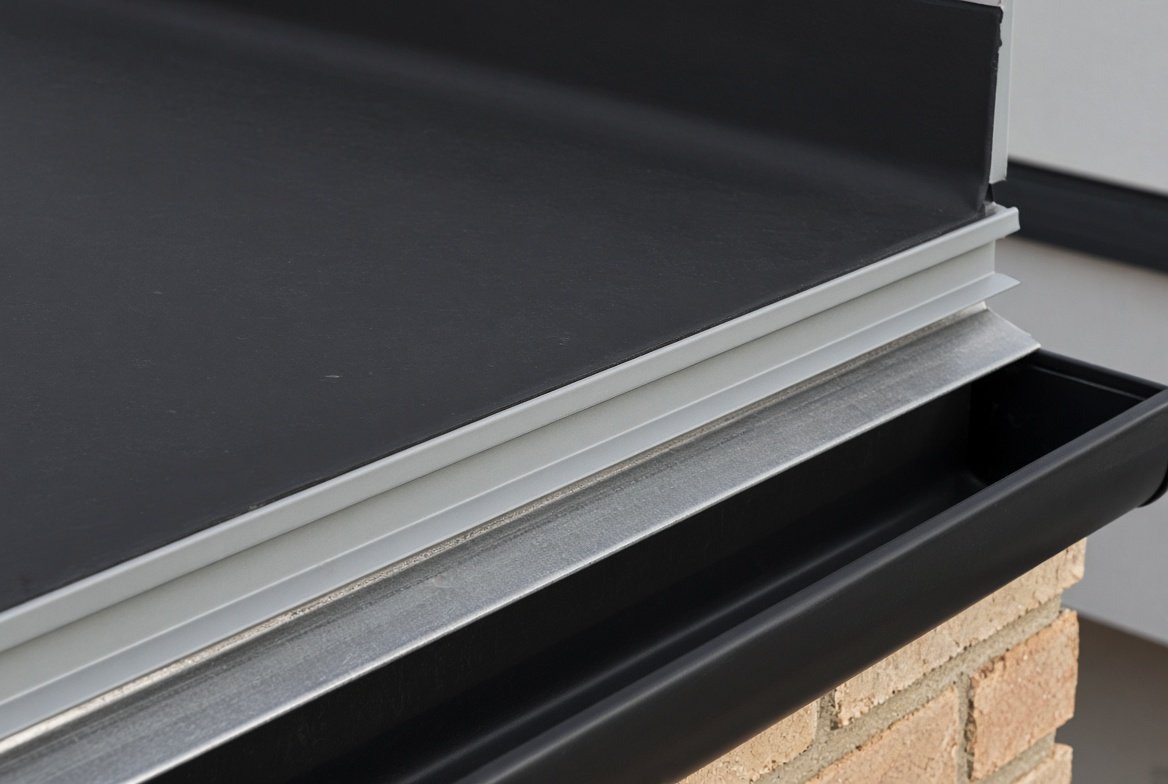
EPDM roofs are known for being simple, because a small roof can be covered in a single sheet of rubber. But the membrane is only half the job. The edges are where an EPDM roof meets the gutter, the wall or a rooflight, and that is where most problems start if the trims are fitted badly.
This guide explains the main EPDM roof edge trims, including gutter trim and drip edge, what they are made from, how they are fitted and what to check before work begins. If you are still choosing a roof covering, see our flat roof materials guide.
What Is an EPDM Roof Edge Trim?
An edge trim is a profile fitted around the edge of a flat roof to finish the membrane neatly and to guide water into the gutter. On an EPDM roof, the rubber is dressed over the edge of the deck, bonded in place, and then covered by a metal or plastic trim that clips or screws on. The trim holds the membrane down and gives the roof a clean line.
Common names for the same family of products include rubber roof edge trim, EPDM drip edge, fascia trim, gutter trim and roof edge kit.
Want a number specific to your roof?
Get matched with local roofers for a free, no obligation quote.
Types of EPDM Trim
Gutter Trim (Drip Edge)
The most important trim on a roof that drains to a gutter. It has a downward lip, called a drip, that projects over the gutter so that water drops into it rather than running behind the fascia. A trim that is too short or fitted without enough overhang is one of the most common reasons for fascia rot.
Edge or Fascia Trim
Used on sides that do not drain to a gutter. It finishes the edge and holds the membrane, and it usually has a short lip to shed water.
Wall Trim and Termination Bar
Where the roof meets a wall, the membrane is turned up the brickwork and held with a termination bar. A flashing or sealed trim covers the top. Our guide to roof flashing explains how these joints are weatherproofed.
Corner Pieces
Pre-formed internal and external corners join the lengths of trim neatly and keep water out of the joints. Cheap kits sometimes skip them.
Rooflight and Kerb Trims
Skylights and roof lanterns sit on upstands, and these need their own trims and sealing. If you are planning one, our guide on what a skylight is explains the main types.
What Are EPDM Trims Made From?
- Aluminium: the most popular choice. Strong, light, corrosion resistant and available in a wide range of powder-coated colours.
- uPVC: cheaper and low maintenance, though it can become brittle with age and can distort in strong sun.
- Galvanised or coated steel: tougher, used on larger or commercial roofs.
Colour is a design choice, but the trim should always be compatible with the membrane and adhesive. Check the manufacturer’s guidance, since some products need specific trims to keep the guarantee valid.
How EPDM Edge Trim Is Fitted
- Prepare the deck edge. The deck and fascia should be sound, straight and clean. Any rot must be repaired first.
- Lay the membrane. The EPDM sheet is bonded to the deck and dressed over the edge, with enough overhang to cover the trim.
- Fix the trim. The trim is fixed along the edge, normally screwed through the deck edge or clipped onto a bracket, with the drip projecting over the gutter.
- Seal the joints. Joints between trim lengths and at corners are sealed with the correct sealant or joint pieces.
- Check the water path. The finished edge should throw water clear of the fascia and into the gutter.
The way the edge is built also affects the layers below the membrane. If the roof is being insulated, see our guide to warm roof construction, because the insulation raises the roof edge and the trim must be sized to suit.
Common EPDM Trim Mistakes
- Trim too short. The water falls behind the gutter or down the face of the fascia.
- Gutter too far away. If the gutter sits too low or too far from the edge, the drip misses it.
- Gaps at corners. Leaving corners unsealed lets water in at the weakest point.
- Wrong adhesive or sealant. Some products attack the rubber or fail to bond.
- Trim fixed to rotten timber. It will not hold, and the roof fails early.
- Membrane stretched over the edge. Stretching creates tension that can pull the membrane away later.
Gutters and Drainage at the Edge
The trim and the gutter work as a pair. The drip edge should sit above the gutter so that water lands in it, and the gutter itself must be level, clear and large enough for the roof. Our guide to roof valleys and guttering shows what to check on the gutter side.
Can You Replace the Trim Without Replacing the Roof?
Sometimes. If the membrane is in good condition but the trim is damaged or has come loose, a roofer can often replace it. The membrane may need to be re-bonded at the edge, so the repair is best done by someone who knows EPDM. If the membrane itself is torn, brittle or wet underneath, a full replacement is usually a better long-term answer.
What to Ask Your Roofer
- What type of trim will be used, and what is it made of?
- How far will the drip project over the gutter?
- Will corner pieces and joint sealants be fitted?
- Is the trim approved by the membrane manufacturer?
- Does the guarantee include the trims and edge details?
Frequently Asked Questions
What is EPDM gutter trim?
It is a metal or plastic profile that finishes the edge of an EPDM roof and directs water into the gutter with a downward drip lip.
What is the best material for EPDM roof edge trim?
Aluminium is the most popular choice because it is strong, light and does not corrode. uPVC is a cheaper alternative.
Do I need edge trim on an EPDM roof?
Yes. The trim holds the membrane in place, gives a neat edge and carries water clear of the fascia. A roof without a proper trim is likely to leak at the edges.
Can I fit EPDM edge trim myself?
It is possible on a small, low roof, but the details are easy to get wrong. A badly fitted trim can cause fascia rot and leaks, so many people use a roofer.
Why is my EPDM roof leaking at the edge?
Common causes are a trim that is too short, unsealed corners, a membrane that has lifted at the edge, or a gutter that is not catching the water.
How long does EPDM edge trim last?
Aluminium trims can last for decades. The roof edge should be checked every year or two for loose fixings and gaps.
Final Thoughts
An EPDM roof is only as good as its edges. A well-chosen trim, fitted with the right overhang and sealed joints, protects the fascia and keeps water out of the structure. When you compare quotes, ask what trims are included and how the edges will be finished.
Get a professional assessment
If you are unsure how much life your current roof has left, a local roofer can give you an honest assessment as part of a free inspection. Browse vetted roofers through our roofer directory, or get a quick replacement estimate using our free cost calculator.