
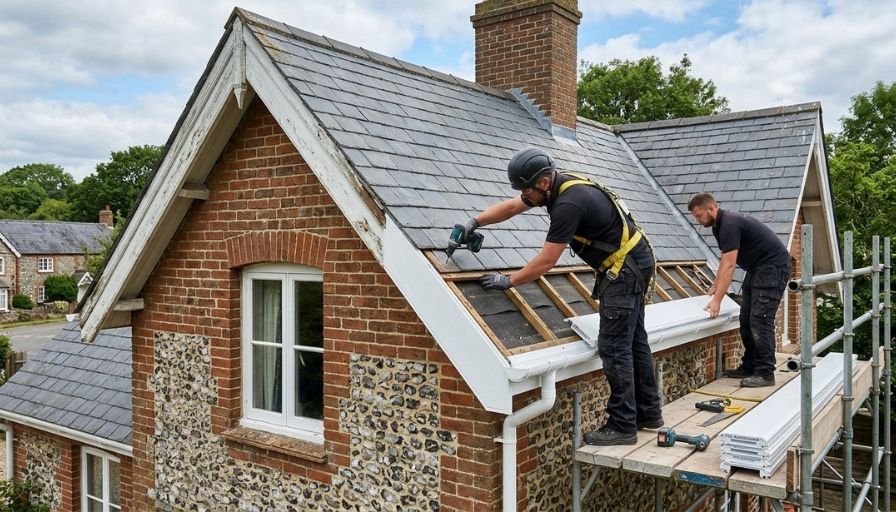
Bargeboards are the boards you see running up the sloping edge of a gable end, finishing the roof where it meets the wall. They are easy to overlook, but they protect the ends of the roof timbers, support the tile overhang at the verge and give the gable its finished look. When they rot, crack or work loose, water and wind get into the roof edge and the whole verge starts to fail. This guide explains what bargeboards are, how they differ from fascias and soffits, the materials and styles available, the signs of trouble, how they are replaced and what the work typically costs in the UK.
What Is a Bargeboard?
A bargeboard, also written barge board and sometimes called a verge board, is a board fixed along the sloping edge of a gable roof, covering the ends of the roof timbers at the verge. It closes the gap between the roof and the wall, protects the timber behind from rain, and in many houses supports the overhang of the tiles or slates at the side of the roof. Hipped roofs, which slope on all four sides, do not have bargeboards because they have no gable end. Our guide to what a gable end is explains the part of the building they belong to.
Bargeboard, Fascia and Soffit: What Is the Difference?
- Bargeboard: follows the sloping edge of the gable end, up the rake of the roof.
- Fascia: the horizontal board along the eaves, which normally carries the gutter. See our guide to fascia boards.
- Soffit: the board underneath an overhang, such as under the eaves. See our guide to what a soffit is.
Bargeboards often meet the fascias at the corners, so the whole roofline is commonly refreshed in one project. Our parts of a roof guide shows how these elements fit together.
What Do Bargeboards Do?
- Cover and protect the exposed ends of the roof timbers at the gable.
- Stop wind-driven rain getting into the roof edge.
- Support or neaten the verge, where the roof covering overhangs the wall.
- Keep out birds, wasps and other pests.
- Give the gable end a finished appearance, particularly on period homes.
Bargeboard Materials Compared
| Material | Pros | Cons | Maintenance |
|---|---|---|---|
| uPVC | Widely available, usually the lowest cost, many colours | Plain look, can yellow or become brittle with age | Wipe clean occasionally |
| Timber | Traditional, suits period homes, can be shaped or carved | Rots if water gets in and paint fails | Regular painting or staining |
| Composite | Rot resistant, can look like timber | Often higher cost, fewer profiles | Low |
| Fibre cement | Durable and stable | Older boards may contain asbestos | Needs careful handling |
Styles and Profiles
Plain flat boards are the most common on modern homes. Period houses, especially Victorian and Edwardian ones, often have decorative bargeboards with scalloped or fretwork edges, and some gables have matching finials at the apex. If your house has decorative boards, think carefully before replacing them with plain uPVC, because they are part of the character of the building. A joiner can often copy a damaged pattern in timber, which may be required if the building is listed or in a conservation area.
Want a number specific to your roof?
Get matched with local roofers for a free, no obligation quote.
Bargeboard Sizes and Fixings
Bargeboards are commonly sold in widths of around 150 to 300 mm, in lengths of a few metres, with full replacement boards usually thicker than thin cover boards. The size depends on the roof design, so measure the existing board and look at how it sits against the tiles and the wall. Boards are normally fixed to the ends of the roof timbers, or to a ladder frame that carries the verge overhang, with corrosion-resistant fixings. Our guide to dry verge roofing explains how the verge is finished where the tiles meet the bargeboard, and our guide to roof timbers explains the structure behind them.
Signs Your Bargeboards Need Attention
- Peeling paint, soft or crumbling timber, especially at the lower ends where water sits.
- Cracks, splits or gaps along the board or at the apex joint.
- Boards that sag, lean away or have come loose from the roof.
- Gaps where birds, wasps or insects get in.
- Brown stains or damp on the gable wall below.
- Warped or discoloured uPVC boards.
- Tiles at the verge that have slipped or lifted, which may point to movement in the boards or ladder frame.
Repair or Replace?
Small patches of surface decay on timber boards can sometimes be cut out, treated, filled and repainted. Widespread rot, structural weakness or boards that no longer hold their fixings usually mean replacement. Cover boards fixed over rotten timber hide the problem, so it is better to strip the old board, check what is behind it and replace anything that is damaged. Because the work is at the roof edge, scaffolding is usually needed. If you are also replacing the eaves boards and gutters, doing it all at once saves paying for access twice, as set out in our guide to fascia and soffit replacement.
How Bargeboards Are Replaced
- Access. A scaffold or tower is set up at the gable end.
- Protect and strip. The old boards are carefully removed, and any lifted verge tiles are secured.
- Inspect the structure. The roof timbers or ladder frame behind are checked for rot or woodworm, and repaired if needed.
- Treat and prepare. Exposed timber ends are treated and prepared for the new boards.
- Fix the new boards. Boards are fixed square and level, with a neat joint at the apex and the eaves corners.
- Seal and finish. End caps, trims and sealing are fitted, and timber boards are primed and painted.
- Check the verge. Tiles and verge details are checked and made good.
Bargeboard Replacement Cost in the UK
Prices vary with material, length, height and access, and sources differ, so treat these as general guides based on 2026 UK price guides. As a guide, bargeboards supplied and fitted in uPVC commonly cost roughly £40 to £65 per metre. As an illustration, a pair of boards totalling about 8 metres on one gable might cost in the region of £300 to £600 for the boards and labour, before scaffolding. Access often costs roughly £400 to £900 per elevation per week, so it can be a large share of a small job. Timber, composite and decorative boards usually cost more. London and the South East are typically 15 to 25 percent above the national average, while the North East, Scotland and Wales are often 10 to 15 percent below. Ask for an itemised quote that shows boards, fixings, scaffold and any repairs to the structure behind.
Maintenance
- Check the gable ends from the ground, using binoculars, at least once a year.
- Repaint or re-stain timber boards before the paint fails.
- Keep gutters and downpipes working so water does not run down the gable.
- Look for gaps and seal them before birds or wasps move in.
- Fix small problems early, before rot spreads into the structure.
Birds, Bats and Pests
Gaps behind bargeboards and fascias can be used by nesting birds and, in some cases, roosting bats, which are protected in the UK. If you see bats or active nests, do not block the gap or disturb them. Get advice from a bat specialist or your local nature conservation body, and plan work outside the nesting season where possible.
Safety and Asbestos
Working at height is dangerous. Bargeboards run up the roof edge at height, and the work involves long boards that catch the wind. Use scaffolding and experienced roofers, and do not work from a ladder resting on the boards.
Asbestos warning. Bargeboards, fascias and soffits made of asbestos cement were used until asbestos was banned in the UK in 1999. Do not drill, cut, sand or break them, and get any suspect board identified by a competent surveyor before any work. The HSE asbestos guidance explains the rules.
Planning and Regulations
Replacing bargeboards like for like normally does not need planning permission in England. Listed buildings and conservation areas often have rules on materials and profiles, so check with your local planning authority before changing the style. Scotland, Wales and Northern Ireland have their own systems. If the gable is shared with a neighbour, as on some semi-detached and terraced homes, talk to them before work starts.
Frequently Asked Questions
What is a bargeboard?
A board fixed along the sloping edge of a gable end that covers the ends of the roof timbers and finishes the verge.
What is the difference between a bargeboard and a fascia?
A bargeboard runs up the sloping gable edge, while a fascia runs along the eaves and usually carries the gutter.
How much does it cost to replace bargeboards?
As a general guide, roughly £40 to £65 per metre fitted in uPVC, plus scaffolding. A pair on one gable might cost a few hundred pounds before access.
What are bargeboards made of?
Most are uPVC or timber, with composite and aluminium options. Older boards may be fibre cement and could contain asbestos.
Can I replace bargeboards myself?
It is possible for a skilled DIYer at low level, but most gables are high and need scaffolding, so many people hire a roofer for safety.
Do all houses have bargeboards?
No. Only houses with gable ends have them. Hipped roofs have no gable and therefore no bargeboards.
Final Thoughts
Bargeboards protect the gable edge of the roof and need to be checked and maintained like any other part of the roofline. Choose a material and style that suits the house, replace rotten boards instead of covering them, and combine the work with fascia and soffit repairs to share scaffolding costs. Work safely, take care with decorative and listed features, and treat any old fibre cement boards as asbestos until proven otherwise.
Get a professional assessment
If you are unsure how much life your current roof has left, a local roofer can give you an honest assessment as part of a free inspection. Browse vetted roofers through our roofer directory, or get a quick replacement estimate using our free cost calculator.