
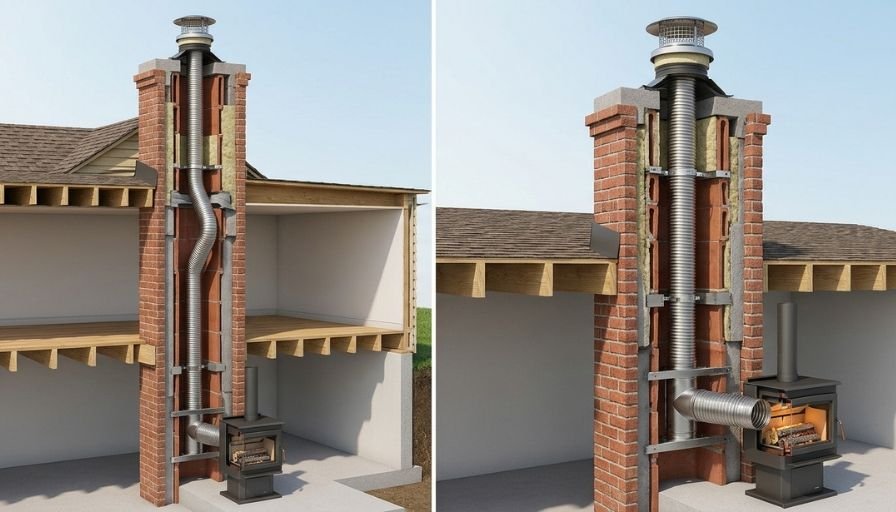
A chimney liner is the pipe or lining inside a chimney that carries smoke and gases from a fire, stove or boiler safely to the open air. Many older chimneys have no liner or a liner that has cracked and decayed, and modern appliances, especially wood burners, put much more demand on a flue than an open fire. A good liner protects the brickwork, stops fumes leaking into the house, helps the appliance draw properly and, for many installations, is a requirement. This guide explains what a chimney liner does, the main types, the difference between 316 and 904 grade stainless steel, typical UK costs, how a liner is fitted and when you need one.
What Does a Chimney Liner Do?
- Protects the masonry. Flue gases contain moisture and acids that attack old mortar and brick from the inside.
- Keeps fumes in the flue. A sound liner stops smoke, tar and carbon monoxide leaking through cracked or porous brickwork.
- Improves draw. A smooth, correctly sized flue carries gases upward more efficiently, which helps the fire burn cleanly.
- Reduces condensation and tar. An insulated liner stays warm, which cuts down on tar and soot build-up.
- Makes sweeping easier. A smooth bore is simpler to clean, as covered in our guide to the chimney sweep.
When Do You Need a Chimney Liner?
- When you are installing a new wood-burning or multi-fuel stove into an existing chimney, which is the most common reason.
- When the existing flue is unlined, cracked or leaking, which a CCTV inspection can show.
- When tar or smoke is seeping through the chimney breast or into neighbouring rooms.
- When the flue size does not match the appliance, for example a small stove in a large old chimney.
- When installing or replacing a gas or oil boiler, where the manufacturer specifies a liner.
- When Building Regulations or your installer require one, for example under the rules for flues and chimneys.
Not every chimney needs a new liner for every appliance, so ask a registered installer to inspect the flue and advise. Solid fuel stove installers are typically registered with HETAS, and gas appliances must be installed by a Gas Safe registered engineer.
Types of Chimney Liner
| Type | Description | Best for | Notes |
|---|---|---|---|
| Flexible stainless steel | Twin-skinned corrugated steel pipe pulled down the existing flue | Most stove installs in existing masonry chimneys | Quickest and most common, grade matters |
| Rigid stainless steel (twin wall) | Insulated sections, often fixed up an outside wall or inside a boxed flue | Houses with no chimney, or where a straight run is needed | Costs more, needs good fixings and planning checks |
| Clay liners | Fired clay pipes set into the chimney as it is built | Open fires and some older chimneys | Can crack, not always suited to stoves |
| Concrete liners | Cast concrete pipes, common in post-war houses | Open fires and gas fires in newer chimneys | Can deteriorate with acidic condensation |
| Cast-in-place (pumice or concrete) | A liner formed inside the flue around an inflatable former | Older brick or stone chimneys with irregular flues | Specialist job, higher cost, very durable |
| Gas or oil boiler flue liner | Smooth flexible liner made for the boiler’s flue gases | Boiler flues in existing chimneys | Must match the appliance maker’s specification |
316 or 904 Grade: What Is the Difference?
Most flexible chimney liners are stainless steel, sold in two main grades. 904 grade has higher corrosion resistance than 316 grade, because of its higher alloy content. As a general guide, 316 grade is commonly specified for a stove burning only seasoned wood, and 904 grade for multi-fuel use, smokeless fuel or heavy use, since these produce more acidic condensate. Some installers and manufacturers recommend 904 grade for any solid fuel appliance, and a liner used with the wrong fuel can fail early or void its guarantee. Always follow the stove maker’s and the liner maker’s guidance, and ask the installer why they have chosen a grade. Quality and guarantees vary between brands, so check how long the guarantee lasts and what it requires, such as regular sweeping.
Liner Size
The liner must match the appliance outlet, and is normally the same size or larger, never smaller. Many domestic stoves use flues of around 125 mm (5 inch) or 150 mm (6 inch) diameter, with larger sizes for bigger appliances, but always check the stove maker’s instructions. A liner that is too large for the appliance can cool the gases too much, causing poor draw and tar build-up. A registered installer will measure the chimney and size the liner properly.
Want a number specific to your roof?
Get matched with local roofers for a free, no obligation quote.
What Is Included in a Liner Kit?
- The flexible liner, cut to the height of the chimney.
- A top plate or clamp, which holds the liner at the top of the stack.
- A chimney cowl or pot hanger. Our guide to chimney cowls, caps and pots explains the options.
- A register or closure plate at the base, with an inspection door.
- A notice plate, which records the details of the installation.
- Insulation, either wrapped round the liner or poured into the void around it, in some installations.
- Connectors to the stove or appliance.
How a Chimney Liner Is Fitted
This is an overview, and the work should be done by a competent, registered installer.
- Sweep and inspect. The flue is swept, and a camera inspection checks for cracks, blockages and bends.
- Prepare the top. The pot may be removed or modified, and the stack is checked. If the stack is damaged, our guide to chimney repair explains what repairs involve.
- Lower the liner. The liner is carefully fed down the flue, in the correct direction as marked, to the bottom.
- Fix the top and base. The top plate and cowl are fitted, and a register plate and connector are fitted at the bottom.
- Insulate. Insulation is added as the system requires.
- Seal and test. A smoke test checks that the flue draws and does not leak.
- Commission. The installer completes a notice plate, gives you a certificate and notifies building control or the registration scheme.
Work on the top of the stack involves roof access and often scaffolding. The base of the chimney also needs sound flashing. See our guides to lead flashing and terraced house roofs if the stack is shared or has damp problems.
Chimney Liner Cost in the UK
Prices vary with the type, the height of the chimney, access and region, and sources differ widely, so treat these as general guides based on 2026 UK price guides.
| Item | Typical range | Notes |
|---|---|---|
| Flexible liner, material only | Roughly £25 to £60 per metre | 316 grade lower, 904 grade higher |
| Flexible liner, supplied and fitted | Roughly £600 to £1,500 | Typical two-storey house with reasonable access |
| Tall, hard-access or twin-wall system | Roughly £1,200 to £2,500 or more | Scaffolding and external runs add cost |
| Clay or concrete relining | Roughly £750 to £1,000 | Less common for stoves |
| Cast-in-place pumice or concrete | Roughly £2,400 to £4,500 | Specialist, long-lasting |
| Pot, cowl and top clamp | Roughly £60 to £200 | Often included in the kit |
| Scaffold to the stack | Roughly £600 to £2,500 | Often the biggest variable |
The liner is only part of installing a stove. The stove, hearth, labour and any building work can bring the total higher. Beware of unusually low quotes, because a very cheap liner may be a lower grade than your fuel needs. Ask what grade, what guarantee and what is included.
Lifespan and Maintenance
Lifespan depends on the grade, the fuel and how well the stove is run. As a rough guide, lower grades may last around 10 to 15 years, and higher grades 15 to 25 years or more, but these are general figures, so check the guarantee. Burning wet wood or running the stove at very low temperatures produces more tar and acid. Sweep the flue at least once a year, more often with heavy use, and keep the certificate for your insurer.
Gas, Oil and Carbon Monoxide
Gas boilers and fires must be installed and serviced by a Gas Safe registered engineer, and oil boilers by a competent registered installer. The liner must match the appliance maker’s specification. Carbon monoxide is odourless and dangerous, so fit working alarms in every room with a fire, stove or boiler, and never block or restrict an active flue. If your alarm sounds or you feel unwell, stop using the appliance, open windows and get advice.
Safety and Asbestos
Working at height is dangerous. Fitting a liner involves working at the top of the stack. Use proper scaffolding and experienced installers, and do not climb onto the roof yourself.
Asbestos warning. Older flue pipes, cement flue sections and flue linings near the chimney may contain asbestos. Do not drill, cut, break or disturb them, and get any suspect material identified by a competent surveyor before any work.
Regulations
New stove and liner installations are covered by building regulations, which in England include rules on flues, hearths and carbon monoxide alarms. Registered installers can self-certify their work, or you can use building control. Stoves above a certain output may need a permanent air vent, and the installer should advise. Listed buildings and conservation areas may have restrictions on the appearance of chimneys. Scotland, Wales and Northern Ireland have their own rules.
Frequently Asked Questions
Do I need a chimney liner for a wood burner?
Usually yes, in an existing masonry chimney, particularly if the flue is unlined, damaged or the wrong size. A registered installer will inspect and advise.
What is the difference between 316 and 904 chimney liners?
904 grade has higher corrosion resistance. 316 is commonly specified for seasoned wood only, and 904 for multi-fuel, smokeless fuel or heavy use. Follow the stove and liner makers’ guidance.
How much does a chimney liner cost?
As a general guide, roughly £600 to £1,500 fitted for a flexible stainless steel liner in a typical house, and more for tall, twin-wall or cast-in-place systems.
How long does a chimney liner last?
Often around 10 to 25 years depending on grade, fuel and use. Check the guarantee and sweep the flue regularly.
Can I fit a chimney liner myself?
It is technically possible but not recommended. The work involves roof access and safety-critical flue connections, and registered installers can certify the job for building regulations and insurance.
Do gas fires need a chimney liner?
Often yes, depending on the appliance and the existing flue. Use a Gas Safe registered engineer to check and follow the manufacturer’s requirements.
Final Thoughts
A chimney liner protects your home, your chimney and your appliance. Have the flue inspected before choosing a liner, match the grade and size to the appliance and fuel, use a registered installer and keep the certificate. Sweep the flue regularly, fit carbon monoxide alarms and treat any old cement flue materials as asbestos until proven otherwise.
Get a professional assessment
If you are unsure how much life your current roof has left, a local roofer can give you an honest assessment as part of a free inspection. Browse vetted roofers through our roofer directory, or get a quick replacement estimate using our free cost calculator.