
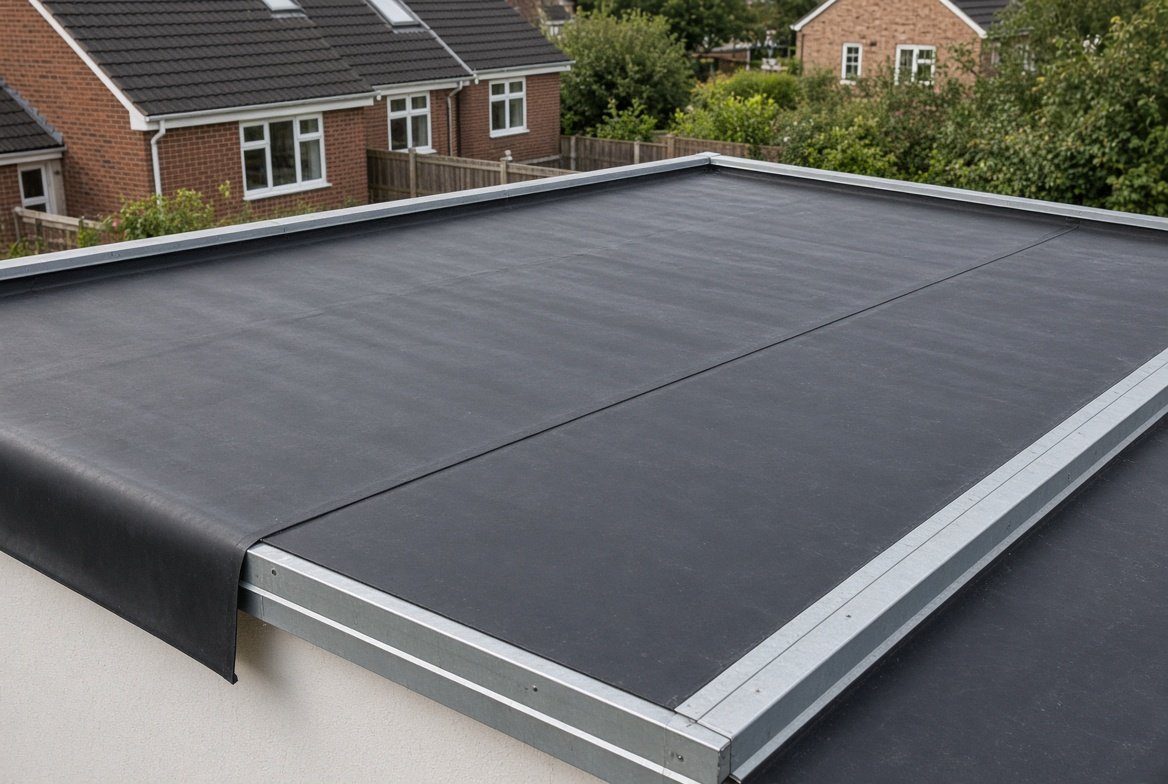
EPDM rubber roofing has become one of the most popular coverings for small flat roofs in the UK, especially on garages, extensions, porches and dormers. It is supplied as a large single sheet of synthetic rubber, so there are very few joins to leak, and it is one of the few flat roof systems that a capable DIYer can fit from a kit. This guide explains what EPDM is, how it compares with other flat roof coverings, what is in a rubber roof kit, how it is installed, what it typically costs and the mistakes that cause problems.
What Is EPDM Rubber Roofing?
EPDM stands for ethylene propylene diene monomer, a durable synthetic rubber. For roofing it is made into a flexible membrane, commonly around 1.0 to 1.5 mm thick (check the manufacturer’s data sheet), usually black, and sold in rolls or cut to size for a particular roof. It stays flexible in cold weather, resists UV light and does not rely on a naked flame to fit. It is used on flat and low-pitched roofs, and it can be stretched around corners and details that would need extra joins with other materials. Our flat roof materials guide compares it with the other main options.
How Long Does an EPDM Roof Last?
As a general guide, a well-installed EPDM roof on a sound, well-drained deck typically lasts 30 to 50 years. Manufacturers and approved installers often offer guarantees, commonly 20 years or more, though the terms vary, so ask what is covered and who has to carry out the work for the guarantee to apply. Lifespan depends heavily on the quality of the installation, especially the adhesive bond, the edge details and how well the roof drains.
EPDM Compared With Other Flat Roof Coverings
| Covering | Typical lifespan | Joins | Notes |
|---|---|---|---|
| EPDM rubber | 30 to 50 years | Often none on a small roof | Flexible, DIY-friendly kits, no flame needed |
| Felt (torch-on) | 15 to 20 years | Several laps | Lower cost, needs a trained roofer |
| GRP (fibreglass) | 25 to 30+ years | Seamless | Rigid, can crack if the deck moves |
| Single ply (PVC/TPO) | 25 to 35 years | Welded seams | Common on larger roofs, needs specialist welding |
If you are weighing EPDM against a welded system, see our guide to single ply membrane roofing.
Want a number specific to your roof?
Get matched with local roofers for a free, no obligation quote.
How an EPDM Roof Is Built
- Deck. A sound, dry, smooth deck, usually plywood or OSB, laid to a fall so water runs to the outlet or gutter.
- Insulation (optional). On a warm roof the insulation sits on top of the deck, directly beneath the membrane, as described in our guide to warm roof construction.
- Membrane. Usually bonded to the deck or insulation with adhesive, though some roofs are mechanically fixed or ballasted.
- Upstands. The rubber is turned up walls, typically at least 150 mm, and secured and sealed with flashing or cover strips.
- Edge trims. Drip trims, verge trims and gutter trims finish the edges, covered in our guide to EPDM roof edge trim.
- Outlets. Flat roofs without a gutter drain through outlets or gullies, which need to be sealed correctly into the membrane.
EPDM Rubber Roof Kits
A rubber roof kit is a ready-to-fit package sized to your roof. It generally includes a single piece of membrane cut to size, bonding adhesive, cleaner or primer, seam or flashing tape, corner patches and a roller or brush. Edge trims and fixings are often sold separately, so check what is included. Kits suit simple, rectangular roofs such as a shed, garage or small extension. When ordering, measure the length and width of the roof, then allow extra for upstands, edge turn-downs and overhangs, as the supplier advises. Complicated roofs with many penetrations, valleys or angles are usually better left to a professional.
How EPDM Is Installed
This is a general overview. Always follow the manufacturer’s instructions, which differ between systems.
- Prepare the deck. Replace rotten boards, remove sharp fixings and make sure the surface is dry, clean and smooth.
- Add insulation if required. Fit it to the manufacturer’s instructions, checking that it is compatible with the adhesive.
- Dry-lay the membrane. Unroll the sheet, position it with the correct overhang and let it relax in mild weather so wrinkles settle.
- Fold back and apply adhesive. Fold half the sheet back, apply adhesive to the deck and the underside of the rubber, let it become tacky as instructed, then roll the sheet into place and smooth out air.
- Repeat for the other half. Work from the middle outwards to avoid trapped air and wrinkles.
- Detail the edges and upstands. Bond the rubber up walls, fit flashing, corners and outlets, and apply sealant or tape as specified.
- Fit edge trims. Finish the perimeter, check the fall and look for punctures or lifted areas.
EPDM Roof Cost in the UK
Prices vary with roof size, access, deck condition, insulation and region, and sources differ, so treat the figures below as wide general guides based on 2026 UK price guides. Small roofs usually cost more per square metre, because labour and trims make up more of the total. London and the South East are often higher.
| Item | Typical range | Notes |
|---|---|---|
| Supplied and fitted, per m² | Roughly £60 to £140 | Higher on small or awkward roofs |
| Garage roof (15 to 25 m²) | About £1,200 to £3,500 | Depends on deck, trims and access |
| Extension roof (20 to 40 m²) | About £1,500 to £5,000 | Insulation and rooflights add cost |
| Warm roof insulation, extra | Roughly £30 to £60 per m² | Depends on thickness required |
DIY kits cost less than a fitted roof, but you still pay for the deck, insulation, trims and your own time and tools. Get a written, itemised quote and ask whether the price includes deck repairs, trims, outlets, waste removal and any guarantee.
Common EPDM Problems and Mistakes
- Fitting on a damp or dirty deck, which weakens the adhesive bond.
- Wrinkles and trapped air from rushing the dry-lay or rolling from the edges instead of the middle.
- Poor upstand and corner detailing, which is where most leaks begin.
- Ponding water caused by an inadequate fall, which accelerates wear and can void a guarantee.
- Wrong adhesive or incompatible insulation, which can damage the membrane or cause it to fail.
- Punctures from tools, sharp debris or later foot traffic. Use walkway pads where the roof will be accessed.
If a flat roof outlet gets blocked, water can build up quickly, so see our guide to the roof gully for how to keep outlets clear.
Safety, Asbestos and Regulations
Working at height is dangerous. Use a stable ladder or platform, edge protection where needed, and never work alone on a roof. Bonding adhesives are often solvent-based and flammable, so work in good ventilation, keep naked flames and smoking well away, and follow the product safety data sheet.
Asbestos warning. Older garages and outbuildings often have corrugated cement sheets, and some contain asbestos. Do not drill, break, scrub or cover over damaged sheets without advice, and get them checked by a competent surveyor first. The same applies to old soffits and similar materials around the roof edge. Our guide to garage roof replacement covers this in more detail.
Replacing a flat roof covering like for like normally does not need planning permission in England, but building regulations may require the roof to be insulated to current standards when a substantial part of the covering is renewed. Check with building control, and note that Scotland, Wales and Northern Ireland have their own rules. Listed buildings and some conservation areas may have extra restrictions.
Frequently Asked Questions
How long does an EPDM roof last?
Typically 30 to 50 years when installed properly on a sound, well-drained deck. Guarantees are often 20 years or more, depending on the manufacturer and installer.
Can I install an EPDM roof myself?
Yes, on a simple, low-risk roof with a kit and the manufacturer’s instructions. Complex roofs, large areas and anything high up are better left to a professional.
Can EPDM be laid over old felt?
Sometimes, but only if the manufacturer allows it and the old surface is sound, dry and compatible. Torch-on felt is often removed or covered by a protective layer first, so check the data sheet.
Does an EPDM roof need insulation?
Not always on a garage, but a warm roof build-up is usually recommended for heated spaces, and building regulations may require it on extensions.
Can you walk on an EPDM roof?
Light foot traffic for maintenance is fine, but it can be punctured by sharp objects. Use walkway pads and avoid regular heavy use unless the system is designed for it.
Is EPDM better than felt?
EPDM usually lasts longer and has fewer joins, while felt typically costs less upfront. The best choice depends on budget, roof size and who is fitting it.
Final Thoughts
EPDM rubber roofing is a long-lasting, flexible and relatively simple option for small flat roofs. Choose a sound deck, a suitable build-up and good edge details, follow the manufacturer’s instructions, and get an itemised quote if you hire a roofer. Check any old cement sheets for asbestos before you touch them.
Get a professional assessment
If you are unsure how much life your current roof has left, a local roofer can give you an honest assessment as part of a free inspection. Browse vetted roofers through our roofer directory, or get a quick replacement estimate using our free cost calculator.