
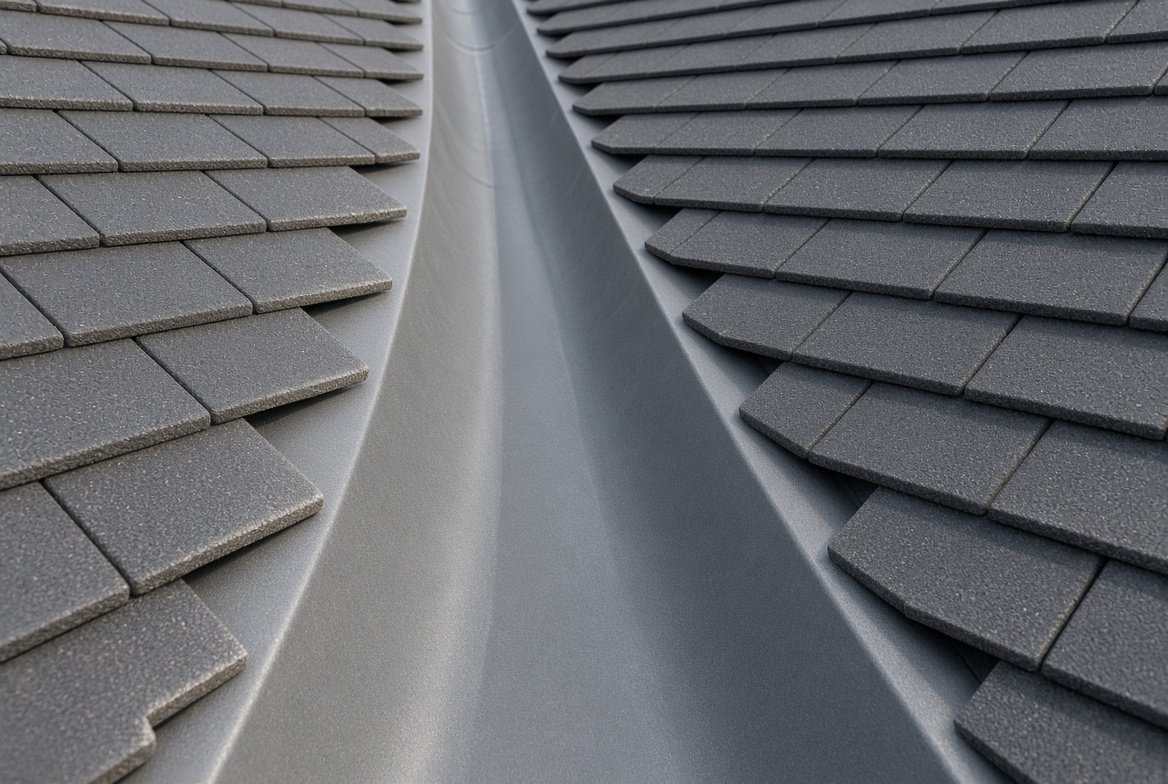
A GRP valley, also called a fibreglass valley, is a pre-formed trough made from glass reinforced plastic. It is fitted in the valley where two roof slopes meet, and it carries rainwater down to the gutter. It is a popular alternative to a lead valley because it is cheaper, lighter and does not corrode.
This guide explains what GRP valleys are, how they compare with lead, how they are fitted and what to check before you choose one. For the basics on valleys in general, see our guide to roof valleys and guttering.
What Is a GRP Valley?
A valley is the internal angle on a roof where two slopes meet. It collects water from both slopes, so it takes more water than almost any other part of the roof. If it fails, the leak can be serious.
A GRP valley is a ready-made fibreglass trough that sits in that angle. The tiles are cut to meet the edges of the trough, and the trough carries the water down. You may also see it called a fibreglass valley, GRP valley trough, valley tray or fibreglass roof valley. They all describe the same type of product.
Want a number specific to your roof?
Get matched with local roofers for a free, no obligation quote.
How a GRP Valley Works
- A timber valley board or supporting framework is fixed along the valley.
- The GRP trough is laid on top, with an underlay or tray beneath it where the system calls for it.
- Where more than one length is needed, the pieces overlap by the amount the manufacturer specifies.
- The roof tiles or slates on each side are cut to follow the valley line and sit over the edges of the trough.
- The trough is fixed through the side flanges, and the tiles are bedded or clipped back to the edge.
The width of the exposed channel matters. Too narrow and water can run across it and under the tiles on the other side, particularly in heavy rain. Follow the manufacturer’s guidance for the width and pitch of your roof.
GRP Valley vs Lead Valley
| Feature | GRP valley | Lead valley |
|---|---|---|
| Cost | Lower | Higher |
| Weight | Light | Heavy |
| Installation | Quick, pre-formed | Skilled, shaped on site |
| Lifespan | Many decades if well fitted | 50 years or more |
| Theft risk | None, no scrap value | Can be targeted |
| Appearance | Plastic look, limited colours | Traditional, weathers to grey |
| Repair | Usually replaced as a section | Can be patched or re-dressed |
Lead is the traditional choice and suits period buildings. To see how it is fitted and which lead code suits a valley, read our lead flashing guide.
Advantages of GRP Valleys
- Cost. They usually cost less than lead, both in materials and in labour.
- Light weight. Easy to handle and gentle on the roof structure.
- Corrosion resistant. Fibreglass does not rust or react with mortar or acids from roof moss.
- No theft appeal. There is no scrap value.
- Quick to fit. The trough is ready-made, so it saves on site time.
- Good on complex roofs. Many suit cross-hipped roofs and different pitches. Our hip roof guide explains why valleys appear on cross-hipped designs.
Disadvantages of GRP Valleys
- Less traditional. On period homes and in conservation areas, lead may be required.
- Can crack. Over many years, UV light and foot traffic can make the surface brittle. Avoid walking in the valley.
- Standard shapes. The trough comes in set angles and widths, which may not fit unusual valleys.
- Colour fade. Colours can weather and may not match the tiles exactly.
- Debris collects. Leaves and moss can build up in the channel and need clearing.
When Is a GRP Valley a Good Choice?
- You want a durable valley on a modern tiled roof without paying for lead.
- Lead theft is a risk in your area.
- The valley is a standard shape that fits a pre-formed trough.
- You are re-roofing and need a quick, reliable valley detail.
Lead is usually the better choice for period homes, very wide or unusual valleys and listed buildings.
Common GRP Valley Problems
- Cracks and splits from age, UV or damage during previous repairs.
- Water running over the edge when the channel is too narrow or tiles are badly cut.
- Blocked channels filled with leaves, moss or tile debris.
- Loose overlaps between lengths, where water can get underneath.
- Damaged edges where tiles were cut too tight or hit the trough.
If you have a stain on a ceiling under a valley, the first step is a close inspection by a roofer. The valley is one of the first places to check when you have a leak.
Replacing a GRP Valley
When a GRP valley fails, the tiles along both sides are lifted, the old trough is removed, the board underneath is checked and a new trough is fitted. This is the same work as relaying the edges of the roof, so it often makes sense to have the valley replaced when the roof is being re-tiled. Poor workmanship is a common reason for early failure, so ask the roofer to show you how they will detail the overlaps and tile edges, and compare quotes before you agree.
How Wide Should a Valley Be?
The exposed channel needs enough width to carry heavy rain without overflowing. The right width depends on the roof pitch, the size of the catchment area and the manufacturer’s guidance. As a general principle, a lower pitch and a larger roof both call for a wider channel. Your roofer should work this out for the particular roof.
If you want to understand how the parts fit together, our guide to the parts of a roof shows where valleys sit in relation to the rafters, hips and ridge.
Frequently Asked Questions
What is a GRP valley?
A GRP valley is a pre-formed fibreglass trough fitted in the valley of a roof to carry rainwater from two slopes down to the gutter.
Is a GRP valley as good as lead?
It is cheaper and lighter and resists corrosion, but lead usually lasts longer and suits period buildings better. Both work well when properly installed.
How long does a fibreglass valley last?
Many decades when it is fitted correctly and not walked on, though UV exposure and damage can shorten the life.
Can you walk on a GRP valley?
You should avoid it. Fibreglass can crack under foot traffic, especially when it is old and brittle.
What is the difference between a GRP valley trough and a valley tray?
The terms are often used for the same product. A trough is the channel itself, and a tray usually refers to the same pre-formed section or the one laid beneath.
Can a GRP valley be repaired?
Small cracks can sometimes be patched, but a damaged trough is more often replaced as a section.
Final Thoughts
A GRP valley is a practical, affordable way to deal with the busiest part of the roof. It suits many modern tiled roofs, as long as it is fitted to the right width and kept clear of debris. If your home is old or listed, or the valley is unusual, lead is the safer choice. Whichever you pick, ask your roofer to explain how the valley will be detailed.
Get a professional assessment
If you are unsure how much life your current roof has left, a local roofer can give you an honest assessment as part of a free inspection. Browse vetted roofers through our roofer directory, or get a quick replacement estimate using our free cost calculator.