
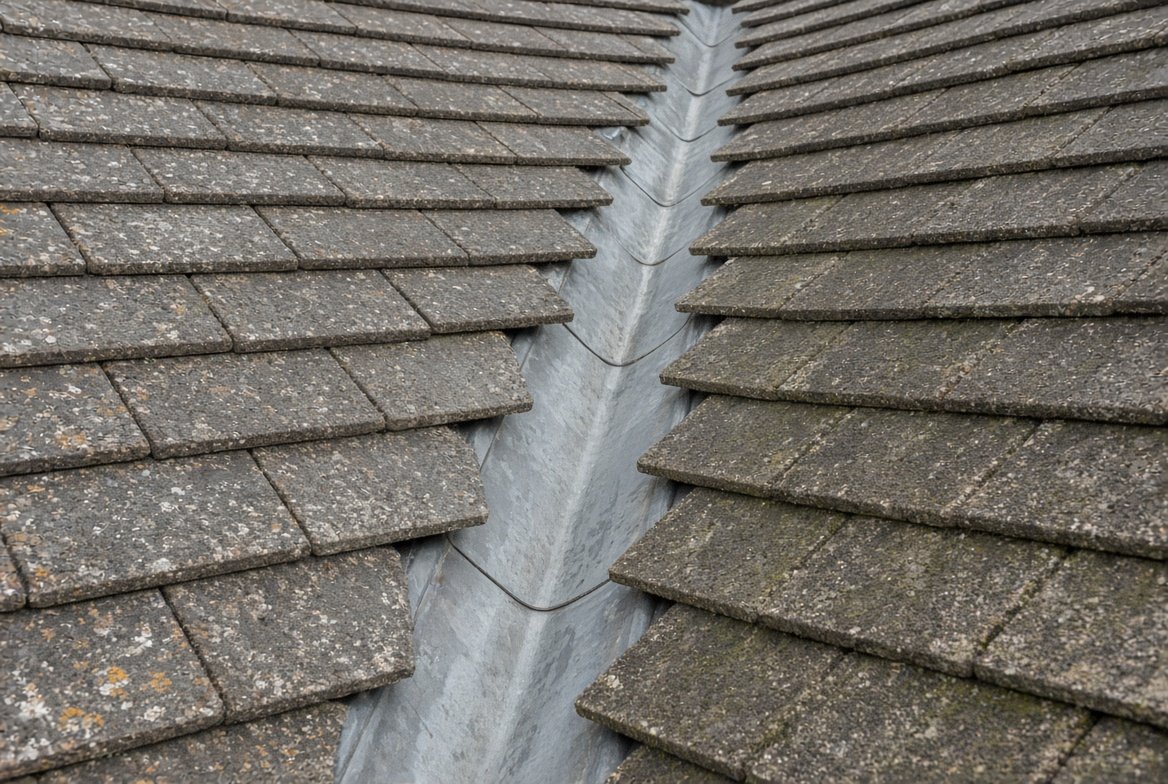
Roof valleys and guttering do the same basic job in different places. Both exist to collect and channel rainwater safely away from a building. Both are also easy to forget about until something goes wrong, since neither is visible from ground level in the way a cracked tile or damaged chimney often is.
What a roof valley is
A valley is the internal angle formed where two sloping roof sections meet, creating a natural channel that collects water from both roof planes at once. Because a valley gathers rainwater from two directions rather than one, it handles a disproportionately large volume of water compared to the rest of the roof, which is exactly why it is one of the more common places for leaks to start.
Valley materials
- Lead. The traditional choice, durable and easy to shape, though it expands and contracts with temperature changes, which can eventually cause cracking or rippling if not installed correctly
- GRP fibreglass. A more modern, seamless option that avoids some of lead’s movement-related issues
- Dry valley systems. Pre-formed units that click or clip into place without needing mortar or extensive on-site shaping
- Concrete or tile valleys. Less common today, using shaped tiles rather than a separate lining material
Common valley problems
- Cracking. Particularly with lead, from repeated thermal expansion and contraction over years of temperature swings
- Blockages. Moss, leaves, and general debris collect easily in a valley’s natural dip, and once blocked, water backs up rather than draining away
- Poorly cut tiles. Where tiles meeting the valley are cut unevenly or too tight, water can creep sideways underneath them through capillary action, a problem that is often visible from outside as an inconsistent tile line
- Membrane laps that don’t overlap correctly. Where a valley liner is not properly lapped, water can be trapped rather than channelled away as intended
One useful diagnostic tip: a genuine valley leak usually shows as water staining along a specific line, often appearing during or shortly after rain, while general dampness on felt or insulation that appears mainly in colder months is more likely to be condensation rather than an actual valley failure. Our guide on how to fix a leaking roof covers this distinction in more detail.
Guttering: the other half of the drainage system
Once water reaches the edge of the roof, whether from a valley or a plain roof slope, guttering takes over, carrying it along the eaves and down through downpipes to the drainage system. UK guttering is most commonly made from uPVC today, though cast iron and aluminium are still found, particularly on older or higher spec properties.
Want a number specific to your roof?
Get matched with local roofers for a free, no obligation quote.
Common guttering problems
- Blockages. Leaves and debris are the single most frequent cause of gutter problems, and a blocked gutter behaves almost like a small dam, forcing water to overflow at the point of blockage
- Sagging or misaligned sections. Over time, brackets can loosen, causing sections to dip and hold standing water instead of draining properly
- Leaking joints. Where sections meet, seals can degrade, letting water escape before it reaches the downpipe
Left unaddressed, both blocked valleys and blocked guttering tend to produce the same downstream problem: water finding its way into the building fabric instead of away from it, which can lead to damp, timber decay, and more serious internal damage the longer it continues.
How to keep both in good condition
- Clear debris from valleys and guttering at least twice a year, more often if there are overhanging trees nearby
- Inspect for cracking, rippling, or lifted sections in valley linings during routine roof checks
- Check that gutters are still properly aligned and pitched toward the downpipes, rather than sagging or holding standing water
- Address small cracks or leaks promptly, since valley and gutter repairs are usually far cheaper when caught early than after water has caused wider damage
Both are worth including in a regular seasonal routine. Our maintenance checklist covers a full season by season approach that includes valley and gutter checks alongside the rest of the roof.
Frequently asked questions
Why do roof valleys leak more often than the rest of the roof?
Valleys collect water from two roof slopes at once, handling a much larger volume than a single plane, which makes any weakness in the material or installation more likely to show up as a leak.
How often should guttering be cleared?
At least twice a year for most homes, typically in spring and autumn, though properties near overhanging trees often need more frequent clearing.
Can a blocked gutter actually cause a roof leak?
Indirectly, yes. Water backing up from a blocked gutter can be forced up under the roof edge or eaves rather than draining away, which can lead to damp and timber damage over time.
Is lead still the best material for roof valleys?
Lead remains highly durable when correctly installed, though its natural expansion and contraction means installation quality matters more than with some alternative materials. GRP fibreglass is a common modern alternative that avoids some of these movement-related issues.
This guide is independent editorial content. It is not sponsored.
Get a professional assessment
If you are unsure how much life your current roof has left, a local roofer can give you an honest assessment as part of a free inspection. Browse vetted roofers through our roofer directory, or get a quick replacement estimate using our free cost calculator.