
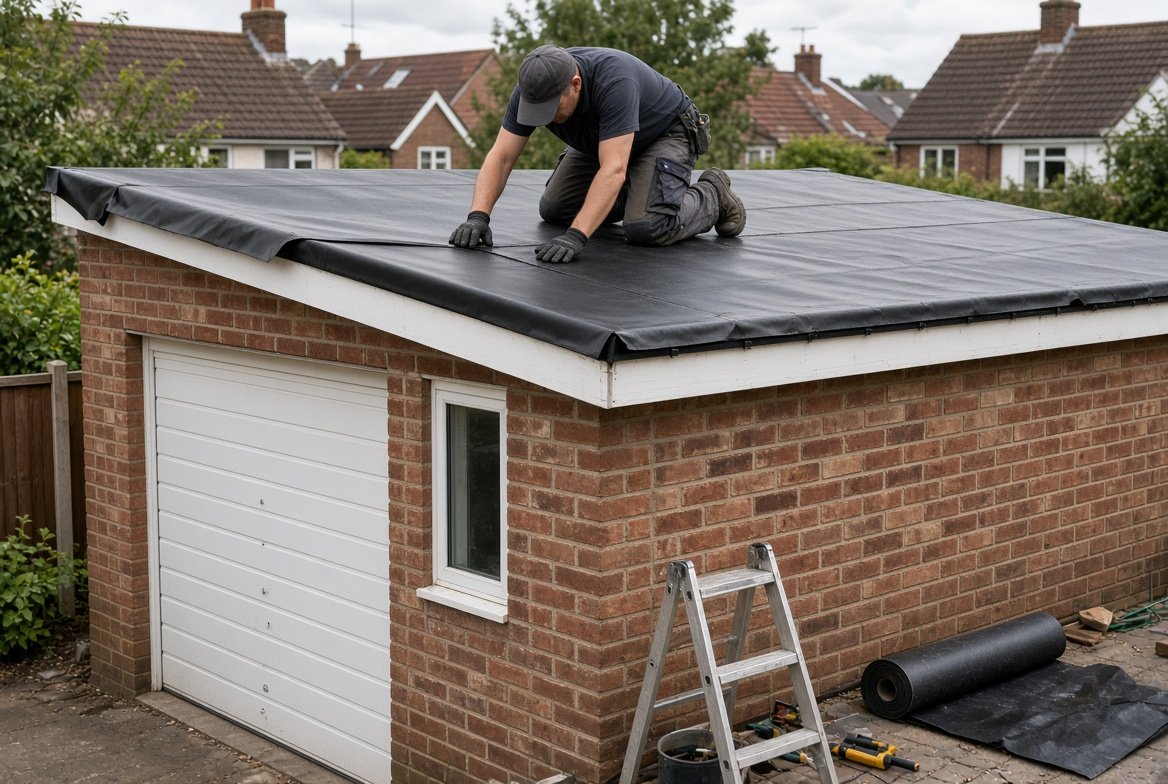
A garage roof does not get much attention until it starts to leak. Because garages are often built to a lower specification than the house, their roofs tend to wear out sooner, and many still carry materials that are no longer used on homes. Replacing the roof is usually a smaller job than re-roofing a house, but the right choice of material makes a big difference to how long it lasts and what it costs.
This guide covers the main garage roof types, the materials you can choose, how to tell when a roof needs replacing, and the safety points to know, especially if your garage has old cement sheeting.
Common Types of Garage Roof
Flat Garage Roof
Very common on attached and integral garages. Flat roofs are normally covered in felt, EPDM rubber or GRP fibreglass. They are cheap to build, but they need a proper fall and regular checks. Our guide to flat roof materials compares the main coverings.
Mono Pitch Garage Roof
A single sloping roof, often used on detached and side-by-side garages. It sheds water easily and is simple to build. Read more in our mono pitch roof guide.
Want a number specific to your roof?
Get matched with local roofers for a free, no obligation quote.
Pitched (Gable) Garage Roof
A traditional two-slope roof, usually tiled to match the house. It gives roof space for storage and generally lasts longer than a flat roof, though it costs more to build.
Sheet Roof (Fibre Cement, Metal or Plastic)
Many older detached garages have corrugated sheets, often made from fibre cement, which can contain asbestos. Newer garages may use corrugated or box profile metal sheets, or insulated roof panels.
Garage Roof Materials Compared
| Material | Typical lifespan | Cost level | Best for |
|---|---|---|---|
| Felt (torch-on) | 15 to 20 years | Low | Budget flat garage roofs |
| EPDM rubber | 30 to 50 years | Medium | Flat roofs, long-term value |
| GRP fibreglass | 25 to 30 years or more | Medium to high | Smaller flat roofs |
| Metal sheeting | 30 years or more | Medium | Detached garages, low pitch |
| Concrete tiles | 40 to 60 years | Medium | Pitched roofs matching the house |
If you are considering a tiled roof, our concrete roof tiles guide explains the profiles and the minimum pitch they need. For a metal covering, see our metal roof guide.
Signs Your Garage Roof Needs Replacing
- Water stains, damp patches or drips inside the garage.
- Sagging or soft areas on a flat roof.
- Cracked, blistered or split felt, or lifting edges.
- Rust, holes or loose fixings on metal sheets.
- Cracked, broken or moss-covered sheets.
- Daylight showing through the roof from inside.
- Repeated repairs in the same area.
For a pitched garage roof with a few slipped tiles, a repair may be enough. Our guide on how to replace roof tiles explains when this is worthwhile.
Asbestos Warning: Old Corrugated Sheet Roofs
Garages built before about 2000 often have corrugated cement sheets, and many of these contain asbestos. Do not drill, cut, scrub or pressure-wash them, and do not break them up yourself. If the sheets are intact, they can sometimes be left alone or covered over, but if they are damaged or need to come off, the work should be done by a licensed contractor. The Health and Safety Executive explains the rules on its asbestos guidance pages. If you are not sure what your roof is made of, have a sample tested before any work starts.
What Affects the Cost of Replacing a Garage Roof?
- Size: a double garage costs much more than a single.
- Material: felt is usually the cheapest, while tiles, metal and GRP cost more.
- Roof shape: flat roofs are usually simpler and cheaper than pitched roofs.
- Structure: rotten timbers, weak joists or a poor fall add repair costs.
- Asbestos: licensed removal and disposal can add a significant amount.
- Insulation: if the garage is used as a workshop or has been converted, a warm roof build-up adds cost.
- Access: an attached garage with tight access takes longer.
Always compare at least three written quotes and check that each includes the same specification. If the garage is being converted, read about warm roof construction before you decide how it should be insulated.
Do You Need Planning Permission?
Replacing the roof covering like for like normally does not need planning permission. Changing the height, shape or pitch of the roof may. Listed buildings and conservation areas have extra rules. Check with your local planning authority before changing anything other than the covering.
How a Garage Roof Is Replaced
- Inspect the structure. The roofer checks the joists or rafters, the deck and the walls for rot or damage.
- Strip the old covering. The old felt, tiles or sheets are removed and disposed of safely.
- Repair the deck or frame. Rotten boards and weak timbers are replaced.
- Add insulation if needed. This is the stage to improve thermal performance.
- Fit the new covering. The new material goes on, with proper edges, flashings and drainage.
- Check the details. Gutters, outlets and wall junctions are tested and finished.
Frequently Asked Questions
How long does a garage roof last?
It depends on the material. Felt lasts 15 to 20 years, GRP and metal about 25 to 30 years or more, EPDM 30 to 50 years and concrete tiles 40 to 60 years.
What is the best material for a garage roof?
For flat garage roofs, EPDM is often the best value over time. For a pitched garage, concrete tiles are a common choice, and metal sheets work well on detached garages with a low pitch.
Can I put a new roof over an old garage roof?
Sometimes. Over-roofing is used on some sheet roofs, but it hides problems in the structure. A roofer will advise based on the condition of the old roof, and asbestos sheets should never be disturbed.
Does my garage roof have asbestos?
If it is a corrugated cement sheet roof built before about 2000, it may. Have a sample tested, and do not cut or drill it.
Can I replace a garage roof myself?
Small repairs may be possible, but a full replacement involves working at height, heavy materials and possibly asbestos. Most people use a roofer.
Final Thoughts
Replacing a garage roof is a practical way to protect what is inside and avoid bigger repair bills. Choose a covering that suits the roof shape and the way you use the garage, check for asbestos before work starts and compare written quotes on the full specification.
Get a professional assessment
If you are unsure how much life your current roof has left, a local roofer can give you an honest assessment as part of a free inspection. Browse vetted roofers through our roofer directory, or get a quick replacement estimate using our free cost calculator.