
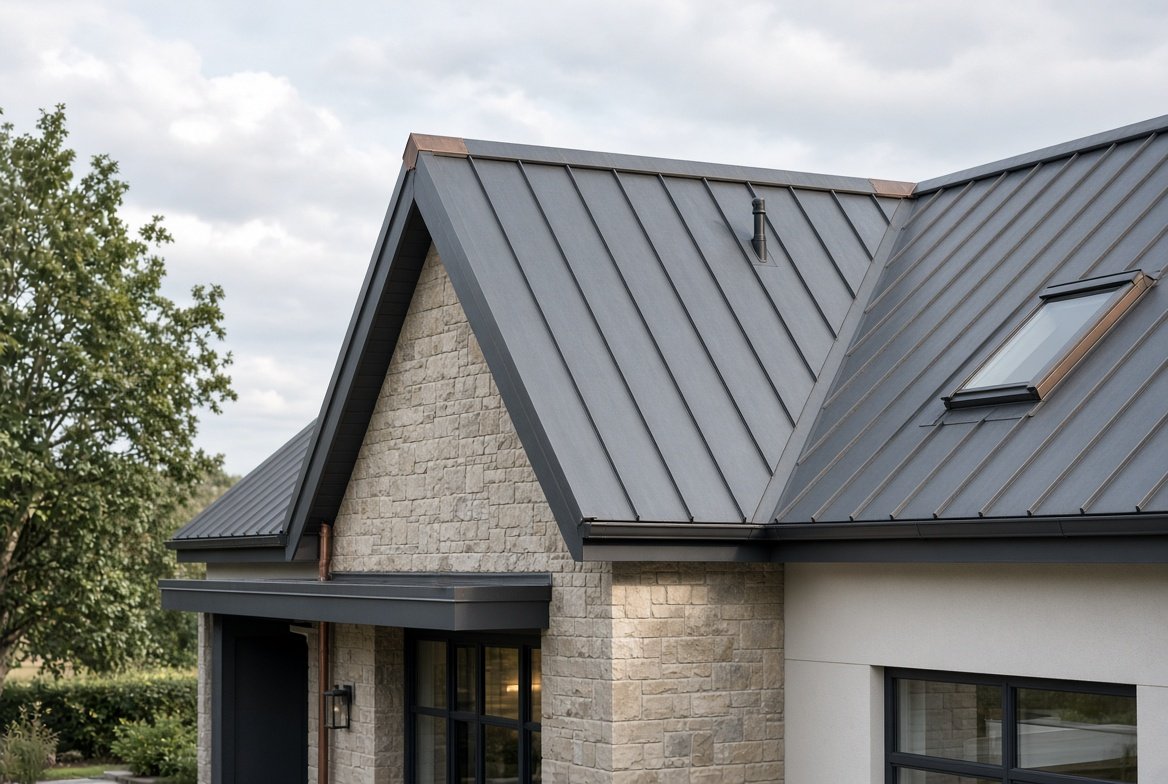
A metal roof is a roof covered in sheets or panels of metal rather than tiles or slates. In the UK, metal roofing has moved from sheds and barns to modern homes, extensions and period renovations, thanks to its light weight, long life and clean appearance.
This guide compares the main types, including zinc, standing seam, aluminium, copper and coated steel. It also explains the pros and cons, the pitch you need and what to ask before you hire an installer.
What Is a Metal Roof?
A metal roof uses metal sheet, joined together to form a continuous waterproof covering. The sheets can be laid in long vertical strips, formed into interlocking panels, or shaped to look like tiles. The metal itself and the way the joints are made are what separate one system from another.
Unlike tiles, which shed water by overlapping, metal roofing works by sealing the joints between large panels. That is why it can be used at much lower pitches than most tiles or slates.
Want a number specific to your roof?
Get matched with local roofers for a free, no obligation quote.
Types of Metal Roof
Standing Seam Roof
A standing seam roof is made of long metal strips with raised vertical seams where the panels join. The fixings are hidden under the seams, so there are no exposed screws. This gives a sleek, modern line, and it is one of the most weathertight metal systems. Standing seam can be made from zinc, aluminium, copper or coated steel, so it describes the method rather than the metal.
Zinc Roof
Zinc is a popular choice for contemporary homes and extensions. It starts out bright and slowly develops a soft grey-blue patina that protects the metal underneath. Zinc is normally installed as standing seam and is valued for its long life and for the way it can be curved. It needs skilled installers, because the metal moves with temperature and must be fixed to allow for that.
Aluminium Roof
Aluminium is very light and resists corrosion well, so it is common near the coast. It is usually supplied with a factory-applied coating in a range of colours. It can be a good lightweight option where the structure cannot carry heavy tiles.
Copper Roof
Copper is the premium metal roof. It begins a bright orange-brown and turns green over many years as a patina forms. It lasts for a very long time and suits landmark and period buildings, but it is the most expensive choice.
Coated Steel Roof
Steel sheets with a protective coating, often in a range of colours, are widely used because they are cheaper than zinc or copper. They are available as standing seam, as tile-effect sheets and as profiled sheets. The coating is what protects the steel, so scratches and cut edges need to be treated properly.
Corrugated and Profiled Sheeting
Corrugated iron, box profile and other profiled sheets are the traditional roofing for barns, garages and outbuildings. They are quick to fit and cost less than standing seam, but the look is more industrial. They are less often used on the main roof of a house.
Metal Roof Pros and Cons
Advantages
- Light weight. A metal roof weighs a fraction of a concrete tile roof, which can avoid the need for structural strengthening.
- Long life. Zinc, copper and quality coated systems can last for decades, often 50 years or more, with little maintenance.
- Works at low pitch. Metal can be used on roofs far shallower than tiles allow, which opens up more design options.
- Fire resistant. Metal is non-combustible, though the full build-up still matters.
- Recyclable. Most roofing metals can be recycled at the end of their life.
- Modern look. Clean lines suit contemporary architecture and extensions.
Disadvantages
- Higher cost. Metal roofs usually cost more than concrete tiles, and zinc and copper can cost more than slate.
- Noise. Rain can sound louder on a metal roof if there is no insulation or acoustic layer underneath.
- Thermal movement. Metal expands and contracts, so the system has to be designed and fixed to allow for it.
- Specialist installation. Not all roofers are trained in zinc or standing seam. Poor installation shortens the life of the roof.
- Can dent or scratch. Softer metals and thin coatings can mark if they are walked on carelessly.
- Metal compatibility. Some metals should not touch or drain onto each other, for example copper running water onto zinc or aluminium.
What Pitch Does a Metal Roof Need?
This is where metal has a big advantage. Standing seam systems can often be used from a pitch of roughly 5 degrees, and some systems go lower still. Profiled sheets and tile-effect panels usually need a steeper roof, so check the manufacturer’s minimum for the exact product. If you want to check the angle of your own roof, use our roof pitch calculator.
Low-pitch metal is especially popular on single-slope roofs. Our mono pitch roof guide explains why they work so well together.
How a Metal Roof Is Built Up
A metal roof is more than the metal sheet. From the top down, a typical build-up includes:
- The metal covering: the standing seam, tile-effect or profiled sheet.
- A separating or acoustic layer: this protects the metal from the surface underneath and can reduce rain noise.
- A solid deck: most standing seam systems are fixed to a plywood or similar deck, rather than battens.
- Insulation and a vapour control layer: to keep the building warm and stop moisture forming under the metal.
Condensation is the main hidden risk, because metal is a cold surface. The usual solution is either a warm roof build-up, where insulation sits above the deck, or a properly ventilated cold roof. Our guide to warm roof construction explains how the layers go together. For roofs with a separate underlay, see roof felt and underlay too.
Metal Roof vs Tiles
| Feature | Metal roof | Roof tiles |
|---|---|---|
| Weight | Very light | Heavy (concrete and clay) |
| Minimum pitch | Low, often around 5 degrees for standing seam | Higher, depending on the tile |
| Cost | Medium to high | Low to medium |
| Lifespan | Often 40 to 100 years, depending on metal | 40 to 100 years, depending on material |
| Repair | Needs specialist skills | Any roofer can replace a tile |
| Look | Modern or industrial | Traditional |
If you are still choosing between materials, our guide to the types of roof tiles sets out the main options on cost, weight and lifespan.
Planning Permission and Metal Roofs
Changing the roofing material on your house to metal can need planning permission, especially in conservation areas, on listed buildings or where a planning condition requires matching materials. A new extension may also have rules about the finish. Always check with your local planning authority before you order materials.
Maintaining a Metal Roof
Metal roofs need very little maintenance, but a short yearly check is worth doing:
- Look for scratches, dents or damaged coatings, particularly on coated steel.
- Clear leaves and debris from valleys, gutters and any flashings.
- Check seams and flashings for any lifted or loose sections.
- Do not use harsh chemicals or abrasive tools on the surface.
- Keep trees trimmed back, so branches cannot scratch the metal in wind.
Avoid walking on the roof unless it is necessary. Where access is needed, use proper roof ladders or boards to spread the load.
What to Ask Your Installer
- Which metal and which system will be used, and why is it right for my roof?
- How will thermal movement, condensation and rain noise be dealt with?
- What is the full build-up from the deck to the metal?
- How will flashings, valleys and penetrations be finished?
- Does the installer have training or accreditation for this specific system?
- What guarantee is offered on the materials, and on the workmanship?
Frequently Asked Questions
What is the best metal for a roof?
It depends on the budget and the building. Coated steel is the most affordable, aluminium is light and good near the coast, zinc is a popular long-lasting choice for modern homes, and copper is the premium option.
How long does a metal roof last?
Depending on the metal and the installation, anywhere from about 40 years for coated systems to 100 years or more for copper. Zinc often reaches 50 years or more.
What is a standing seam roof?
It is a roof made of long metal panels joined with raised vertical seams. The fixings are hidden underneath, which gives a clean look and a very weathertight finish.
Is a metal roof noisy in the rain?
It can be, if there is no insulation or acoustic layer under the metal. With a proper build-up, the noise is similar to other roofs.
Can you put a metal roof on a low-pitch roof?
Yes. Standing seam systems can often be fitted from around 5 degrees, and some go lower. Always check the manufacturer’s minimum pitch for the product.
Do metal roofs need planning permission?
Not always, but changing the material can need permission in conservation areas and on listed buildings. Check with your local planning authority before you start.
Final Thoughts
A metal roof can be a smart choice for a modern home, an extension or any building where weight or low pitch matters. It costs more than tiles, and it needs a skilled installer, but the long life and low maintenance make it good value over time. Get several detailed quotes, ask about the full build-up and make sure the installer has experience with the exact system.
Get a professional assessment
If you are unsure how much life your current roof has left, a local roofer can give you an honest assessment as part of a free inspection. Browse vetted roofers through our roofer directory, or get a quick replacement estimate using our free cost calculator.