
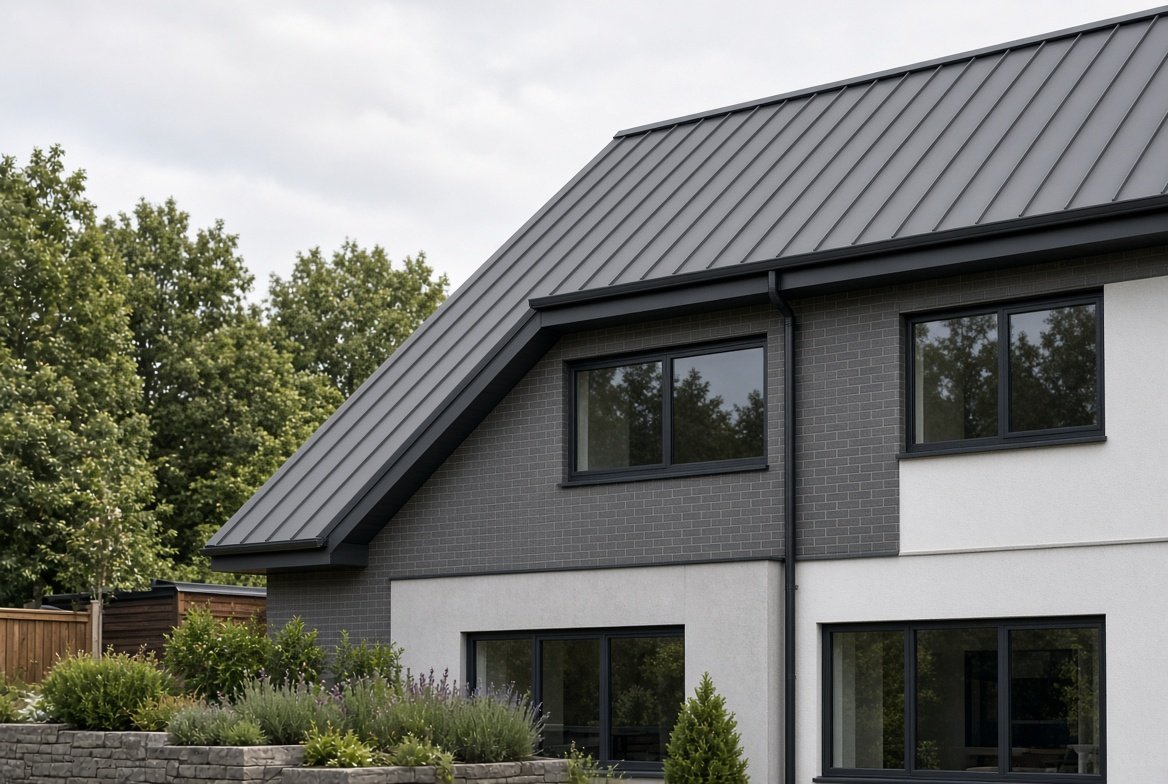
A standing seam roof is a metal roof made from long panels that join together with raised vertical seams. The fixings are hidden under the seams, so the surface is smooth, with no exposed screws or nails. It has become a favourite on modern homes and extensions, and it is also used on barns, garages and commercial buildings.
This guide explains how a standing seam roof works, the metals it is made from, its pros and cons, the pitch it needs and what affects the cost. For an overview of all metal roofing types, see our metal roof guide.
What Is a Standing Seam Roof?
A standing seam roof is made of continuous metal panels that run from the ridge down to the eaves. Where two panels meet, the edges are turned up and folded together to form a raised seam. Because the seam sits above the flat surface of the panel, rainwater runs along the flat part and does not pass over the joint.
The panels are held to the roof by hidden clips that are fixed to the deck and locked inside the seam. This means the roof surface has no holes for water to get into, and the metal is free to expand and contract with the temperature.
Want a number specific to your roof?
Get matched with local roofers for a free, no obligation quote.
Types of Standing Seam Joint
- Single lock: the edge of one panel is folded over the edge of the next, forming a simple raised seam.
- Double lock: the seam is folded twice, which makes a tighter and more weathertight joint. It is used on lower pitches and in more exposed places.
- Snap-lock: factory-formed panels click together without on-site folding, which makes installation quicker.
The right joint depends on the pitch, the metal and the manufacturer’s system.
What Metals Are Used?
- Zinc: a popular choice for contemporary homes. It develops a soft grey patina, lasts for many decades and can be shaped around curves.
- Aluminium: light and corrosion resistant, often supplied with a factory coating in many colours. A good option near the coast.
- Coated steel: the most affordable option, with a protective coating to prevent rust. The coating should be looked after, as scratches can expose the steel.
- Copper: the premium choice. It starts bright and turns green over time, and it can last for more than a century.
- Stainless steel: very durable, used on high-end and specialist projects.
Advantages of a Standing Seam Roof
- Weathertight. Hidden fixings and raised seams reduce the places where water can get in.
- Long life. Quality systems can last for decades with little maintenance.
- Works at low pitch. Standing seam can often be fitted at a much lower pitch than tiles. Our roof pitch calculator can tell you the angle of your roof.
- Light weight. Metal weighs far less than tiles, so it puts less load on the structure.
- Clean modern look. The long straight lines suit contemporary design.
- Fire resistant and recyclable. Metal is non-combustible and can be recycled at the end of its life.
Disadvantages of a Standing Seam Roof
- Higher cost. It usually costs more than concrete tiles, and zinc and copper cost the most.
- Specialist skills. The seams, clips and details must be formed correctly, and not every roofer is trained.
- Noise. Without insulation or an acoustic layer, rain can sound louder.
- Thermal movement. Long panels expand and contract, so the system has to allow for it.
- Can mark or dent. Soft metals can be scratched or dented, so be careful with access.
- Harder to repair. A damaged panel often needs to be replaced as a long strip, not patched as a single tile.
What Pitch Does a Standing Seam Roof Need?
Standing seam systems can work at low pitches. Many are used from around 5 degrees, and some systems go lower. The exact minimum depends on the metal, the type of seam and the manufacturer. A single-slope roof is a common use, and our mono pitch roof guide explains why the two work well together. Always check the minimum pitch for your product, especially in exposed locations.
How a Standing Seam Roof Is Built
- Structure and deck. A solid, flat deck, normally plywood, is fixed to the rafters.
- Underlay or separation layer. A membrane sits on top of the deck. It protects the metal and can reduce noise.
- Clips. Hidden clips are fixed to the deck at set spacing.
- Panels. The metal panels are laid and the seams are locked together over the clips.
- Edges and details. Eaves, ridges, verges, flashings and penetrations are formed in matching metal.
The layers beneath the metal matter for condensation, since metal is a cold surface. Most standing seam roofs are built as warm roofs, with insulation above the deck. Our guide to warm roof construction explains how the layers fit together.
Details Where Metal Meets Walls and Chimneys
Wherever the roof meets a wall, a chimney or a rooflight, a flashing is needed. On a metal roof, flashings are usually made from the same metal to avoid reactions between different metals. Our guide to roof flashing explains the basics of how these joints are sealed.
What Affects the Cost of a Standing Seam Roof?
- Metal: coated steel is cheapest, followed by aluminium, zinc and copper.
- Roof shape: simple rectangular roofs cost less than complex ones with hips, valleys and curves.
- Panel type: factory-made panels are quicker to fit than ones folded on site.
- Insulation and build-up: a warm roof with an acoustic layer adds cost.
- Installer: specialist installers charge more for good reason.
- Access: scaffolding and lifting long panels can add to the price.
Because prices vary so much, get at least three detailed written quotes and ask each installer what is included.
Maintaining a Standing Seam Roof
- Inspect the roof once a year for scratches, dents and loose flashings.
- Clear leaves and debris from the gutters and valleys.
- Do not use harsh chemicals or abrasive tools on the metal.
- Keep tree branches trimmed back so they cannot rub the surface.
- Avoid walking on the roof. Use boards or proper access equipment when it is unavoidable.
Questions to Ask Your Installer
- Which metal and which system do you recommend, and why?
- How will thermal movement, condensation and rain noise be handled?
- What is the full build-up from deck to metal?
- How will the flashings, edges and penetrations be detailed?
- Do you have manufacturer training or accreditation for this system?
- What guarantee do you offer for the materials and the workmanship?
Frequently Asked Questions
What is a standing seam roof?
It is a metal roof made of long panels joined with raised vertical seams. The fixings are hidden under the seams, which gives a clean look and a weathertight finish.
How long does a standing seam roof last?
Quality systems commonly last 40 to 60 years, and zinc and copper can last longer. The installation and the metal both affect the life.
What is the minimum pitch for a standing seam roof?
Many systems start at around 5 degrees, and some go lower, but it depends on the metal and the seam type. Always check the manufacturer’s guidance.
Is a standing seam roof noisy in the rain?
It can be without insulation or an acoustic layer. With a proper build-up, the noise is similar to other roof types.
Is standing seam better than a tiled roof?
It depends on your priorities. Standing seam is lighter, works at lower pitches and suits modern designs, while tiles generally cost less and suit traditional homes.
Can you install a standing seam roof over an existing roof?
Sometimes, depending on the condition of the existing roof and the structure. A roofer will check whether the deck and structure are suitable.
Final Thoughts
A standing seam roof is a smart choice for a modern home or extension, especially when the pitch is low or weight is a concern. It costs more than tiles, so the key is to choose the right metal and an installer with real experience of the system. Ask for a full specification and compare more than one quote before you commit.
Get a professional assessment
If you are unsure how much life your current roof has left, a local roofer can give you an honest assessment as part of a free inspection. Browse vetted roofers through our roofer directory, or get a quick replacement estimate using our free cost calculator.