
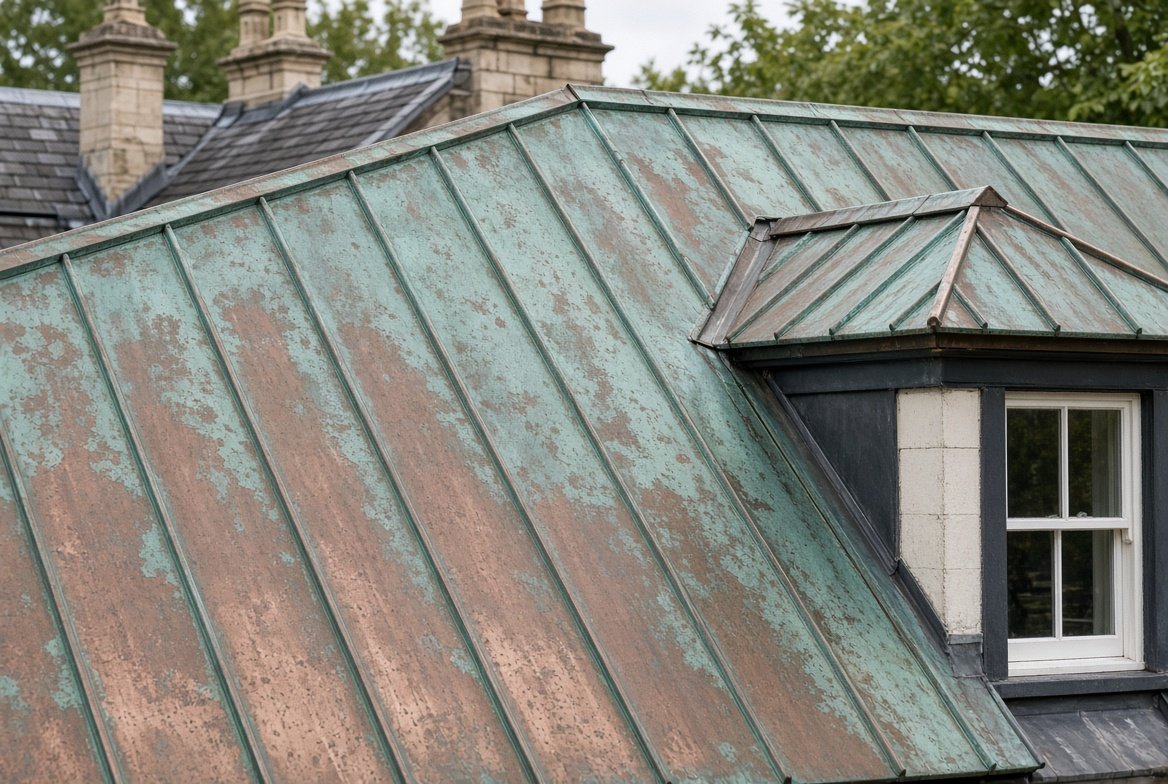
Copper is the most prestigious roofing metal. It starts out a bright, shiny orange-brown, slowly darkens, and eventually turns a soft blue-green as a natural patina forms. Copper roofs can last for well over a century with very little maintenance, which is why you will see them on cathedrals, town halls and country houses, as well as on modern extensions, dormers and porches.
This guide explains how a copper roof works, how the patina develops, the pros and cons, the cost factors and what to check before choosing it. For an overview of all roofing metals, see our metal roof guide.
What Is a Copper Roof?
A copper roof is covered in sheets or panels of copper, joined with folded seams that keep water out. It can be laid as long standing seam panels, as flat-lock sheets that look like small interlocking tiles, or as batten roll, where the sheets are folded over timber battens. Copper is soft enough to be shaped by hand, so it can cover domes, curves and complicated roof forms that other metals struggle with.
How Copper Changes Colour
Copper reacts with oxygen and moisture in the air, and the surface slowly changes.
Want a number specific to your roof?
Get matched with local roofers for a free, no obligation quote.
- Bright and new: a shiny, salmon-pink to orange-brown colour.
- Darkening: over months, the surface turns a deeper brown.
- Patination: over many years, a green-blue layer called verdigris starts to form.
How fast this happens depends on the climate, the pitch of the roof and the environment. Coastal and polluted areas tend to patinate faster, while a dry, clean environment can take much longer. The patina is not damage. It is a protective layer that shields the metal underneath and is one reason copper lasts so long.
Pre-Patinated Copper
If you want the aged look straight away, factory-treated copper is available. It comes in brown or green finishes and gives a consistent appearance from day one. It usually costs more than standard copper.
Advantages of a Copper Roof
- Very long life. A well-fitted copper roof can last 100 years or more.
- Low maintenance. It needs no painting or coating, and the patina protects it.
- Light weight. It puts far less load on the roof structure than tiles.
- Works at low pitch. It can be used at much lower pitches than tiles, which is useful on extensions and curved roofs.
- Easy to shape. Copper can follow curves, domes and detailed forms.
- Moss resistance. Copper ions help to discourage moss and algae.
- Fire resistant and recyclable. It does not burn, and it keeps its scrap value.
- Distinctive look. The colour change gives a roof real character.
Disadvantages of a Copper Roof
- High cost. Copper is one of the most expensive roofing materials, both for the metal and for the specialist labour.
- Specialist installation. Not every roofer is trained to work in copper. Poor seams or fixings shorten its life.
- Theft risk. Copper has strong scrap value, so it can be targeted in some areas. Check your insurance.
- Staining. Water running off copper can stain brickwork, stone, render and other roofing materials green.
- Thermal movement. Copper expands and contracts with temperature, so the system must allow for movement.
- Rain noise. Without insulation or an acoustic layer, rain can sound louder than on tiles.
- Colour change is not for everyone. If you want the roof to stay bright, copper is not the right choice.
Copper and Other Metals: Keep Them Apart
Copper should not be in direct contact with, or drain onto, zinc, aluminium or galvanised steel. The metals react with each other and the less noble one corrodes, a process called galvanic corrosion. Run-off from copper can also damage gutters and flashings made from other metals. On a copper roof, use copper or compatible fixings, gutters and flashings throughout. Our guide to roof flashing covers the basics of how flashings work.
Types of Copper Roofing
- Standing seam: long panels with raised folded seams. The most popular modern method. See our guide to the standing seam roof for how it works.
- Batten roll: sheets joined over timber battens, giving a traditional ribbed look.
- Flat lock: small flat sheets locked together in a pattern, often used on curved and detailed roofs.
- Copper shingles or tiles: individual pieces that give a scaled look.
Where Copper Roofing Is Used
- Period and listed buildings, where copper is part of the original character.
- Domes, turrets and curved roofs.
- Dormers, bay window roofs and porch canopies. Our guide to dormer roofs and loft conversions explains where dormers fit in.
- Modern extensions and architect-designed houses.
- Flashings, valley linings and roof trims on traditional roofs.
What Pitch Does a Copper Roof Need?
Copper can generally be used at lower pitches than tiles, and many standing seam systems work from around 5 degrees or less. The exact minimum depends on the type of seam, the length of the run and the manufacturer’s advice. If you are not sure of your roof angle, use our roof pitch calculator.
How a Copper Roof Is Built Up
A typical copper roof is laid on a solid deck, with a separating layer between the deck and the copper. The separating layer protects the metal and can reduce noise. Insulation is usually placed above or below the deck, depending on whether the roof is built as a warm or a cold roof. Because copper is a cold surface, condensation control is important. Our guide to warm roof construction explains the build-up most roofers recommend for metal roofs.
What Affects the Cost of a Copper Roof?
- The price of copper: the metal price changes with the market.
- Thickness and finish: pre-patinated copper costs more.
- Roof shape: curves, domes and many details increase the labour.
- Roof size and access: scaffolding and lifting add to the bill.
- Build-up: a warm roof with an acoustic layer adds cost.
- Installer: specialist copper roofers charge more.
Prices vary widely, so get several detailed written quotes and compare the full specification.
Maintaining a Copper Roof
- Check the roof once a year for loose seams, dents and damaged flashings.
- Clear leaves and debris from gutters and valleys.
- Do not clean the patina off or use harsh chemicals.
- Avoid walking on the roof. If you need access, use boards or proper equipment.
- Have any repairs done by someone who knows copper.
Questions to Ask Your Installer
- What type of copper and which system do you recommend?
- How will thermal movement, condensation and rain noise be dealt with?
- What is the full build-up from the deck to the copper?
- Will you use copper or compatible fixings, gutters and flashings throughout?
- Do you have experience of copper roofing, and can I see previous work?
- What guarantee do you give for the materials and the workmanship?
Frequently Asked Questions
How long does a copper roof last?
A well-installed copper roof commonly lasts 100 years or more, which is longer than most other roofing materials.
Why does a copper roof turn green?
Copper reacts with oxygen and moisture over time and forms a green-blue layer called a patina. It protects the metal and is a normal part of ageing.
How long does it take for a copper roof to turn green?
It depends on the climate and the roof, but usually many years. Coastal and polluted areas tend to patinate faster.
Is a copper roof worth the money?
It costs a lot upfront, but its long life, low maintenance and appearance can make it good value over time, especially on a house you plan to keep.
Can copper roofing be used with aluminium or zinc gutters?
No. Copper should not touch or drain onto zinc, aluminium or galvanised steel, because it can cause corrosion. Use copper or compatible materials throughout.
Do copper roofs need planning permission?
Not always, but changing the material can need permission in a conservation area or on a listed building. Check with your local planning authority.
Final Thoughts
A copper roof is an investment in a material that looks better with age and can outlast almost any other covering. The cost and the need for a skilled installer mean it is not for every project. If you like the idea, ask for a full specification, check that compatible materials are used throughout and compare more than one quote before you decide.
Get a professional assessment
If you are unsure how much life your current roof has left, a local roofer can give you an honest assessment as part of a free inspection. Browse vetted roofers through our roofer directory, or get a quick replacement estimate using our free cost calculator.