
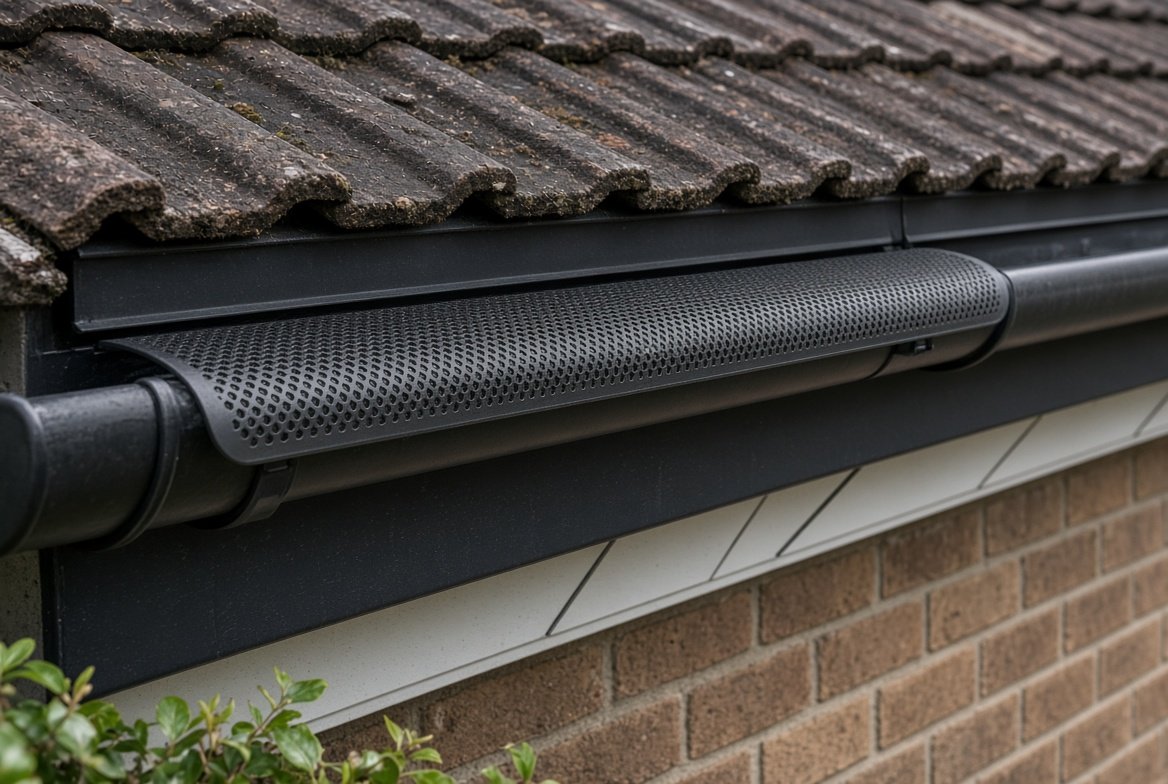
Gutter guards promise to keep leaves, moss and debris out of your gutters so you never have to climb a ladder again. The reality is more mixed. A good guard fitted to a sound gutter can cut the number of times you need to clear it, especially near trees, but no guard removes maintenance completely. Some types trap more than they release, some are tricky to fit under roof tiles and some cost more than years of professional cleaning. This guide explains the main types of gutter guard, their pros and cons, UK costs, how they are fitted and whether they are worth it for your home.
What Are Gutter Guards?
A gutter guard is a cover, mesh or insert that sits on or inside the gutter. It lets rainwater pass through while keeping most leaves, twigs, moss clumps and nesting material out. Some systems clip on top, some are laid inside the channel and some are covers that slide under the lowest row of roof tiles. Guards are sometimes called leaf guards, gutter mesh, gutter covers or, for the brush type, gutter hedgehogs. Our guide to gutter cleaning explains the maintenance that guards aim to reduce.
Types of Gutter Guard
| Type | How it works | Pros | Cons |
|---|---|---|---|
| Brush guard (gutter hedgehog) | A long bristled cylinder laid inside the gutter | Cheap, flexible, easy to fit | Traps debris on the bristles, reduces flow, needs regular cleaning |
| Plastic mesh or grille | A perforated cover that clips over the gutter | Low cost, light, stops larger leaves | Can become brittle, small debris passes through |
| Aluminium or steel mesh | A rigid, finer mesh or perforated panel | Durable, stops finer debris | Costs more, harder to fit around brackets |
| Foam insert | A foam block pushed into the channel | Very cheap | Soaks up water and moss, rots, short life |
| Solid cover or hood | A covering that guides water into the gutter around a lip | Strong protection from large debris | Most expensive, trickier to fit, suits only some profiles |
| Downpipe or outlet guard | A small cage or strainer at the outlet | Stops blockages at the downpipe | Needs regular clearing |
How Well Do Gutter Guards Work?
Guards cope best with larger debris, such as leaves and twigs. They are less effective against fine grit, roof sand, seeds, pollen and the silt that washes off roof tiles, which collect in the gutter beneath the guard. Moss can also grow on top of some guards. In heavy rain, a clogged mesh can cause water to overshoot the gutter. Most roofers agree that guards reduce the number of cleans, but do not remove the need for checks, usually at least once a year.
Pros and Cons
Advantages
- Fewer blockages from leaves and twigs, especially near trees.
- Fewer trips up a ladder.
- Some protection against birds nesting in the gutter.
- Potentially less water overflow and damp staining on walls.
Disadvantages
- Cost, especially for mesh and solid systems.
- Fine debris and silt still build up beneath the guard.
- Cleaning a gutter with a guard can be harder, as you may have to lift it first.
- Some guards trap moss, snow and ice.
- Cheap guards can warp, crack or blow off.
- Fitting some types means lifting roof tiles, which can damage them.
Gutter Guard Cost in the UK
Prices vary with type, gutter length and access, and sources differ, so treat these as general guides based on 2026 UK price guides.
Want a number specific to your roof?
Get matched with local roofers for a free, no obligation quote.
| Type | Typical cost per metre | Notes |
|---|---|---|
| Foam insert | Roughly £2 to £5 (materials) | Often needs replacing within a few years |
| Brush guard | Roughly £3 to £10 | DIY friendly, labour adds to the price |
| Plastic mesh | Roughly £2 to £8 | Shorter life than metal |
| Aluminium or steel mesh | Roughly £6 to £20 | Fitted prices are higher |
| Solid cover or hood | Roughly £15 to £40 | Often a premium system |
As a general guide, a professionally fitted system on a typical three-bed semi with around 25 to 30 metres of guttering often costs somewhere between £250 and £800 depending on the type and access, with premium systems costing more. Fitting guards while the gutters are being replaced is usually cheaper than adding them later. For comparison, professional gutter cleaning commonly costs roughly £50 to £250 per visit, as set out in our gutter cleaning guide, so the payback depends on how often your gutters actually block.
How Long Do Gutter Guards Last?
As a rough guide, foam inserts last a few years, brush guards and plastic mesh often last about 5 to 10 years, and good aluminium or steel systems can last longer. UV, frost, moss and snow load shorten the life of cheaper products. Ask what the guarantee covers.
Are Gutter Guards Worth It?
They are most worth considering when:
- You have large trees overhanging the roof, especially evergreens that shed needles.
- The gutters are high or hard to reach safely.
- You or an elderly relative can no longer climb a ladder.
- Gutters have blocked repeatedly and caused overflow or damp.
They are less worthwhile when the house has few trees nearby, the gutters are low and easy to clear, or the gutter is already in poor condition. A guard fitted over a leaking joint or a sagging run simply hides the fault. Fix those problems first, as our guide to gutter repair explains.
Which Guard Suits Which Gutter?
- Standard half round and square uPVC: most brush and mesh guards fit. Check the width and the manufacturer’s compatibility notes. Our guide to types of guttering explains the common profiles.
- Ogee, deep flow and cast iron: some guards are made for these shapes, but many are not, so check before buying.
- Valley and bonding gutters: these are built into the roof, and a guard in these needs specialist advice. See our guide to roof valleys and guttering.
- Roofs with a lot of moss: moss debris can clog guards, so treat the moss first. See our roof moss removal guide.
How Gutter Guards Are Fitted
This is an overview, and the manufacturer’s instructions always come first.
- Clean and repair the gutter. Remove all debris and silt, fix leaks and make sure the gutter drains.
- Check compatibility. Measure the gutter width and check the roof edge.
- Cut the guard to length. Cut sections to fit between brackets and corners.
- Fit the guard. Brush guards are laid inside the channel, mesh and covers are clipped over the gutter, and some slide under the first row of tiles or the roof felt.
- Secure around brackets, corners and outlets. Leave the outlet clear so water can drain.
- Test with water. Run a hose along the gutter and check that it drains without overshooting.
Take care with any guard that slides under the roof covering, because tiles and felt can be damaged if they are lifted incorrectly, and some roof warranties may be affected. If you are not sure, ask a roofer to fit it.
Maintenance After Fitting
- Check the guards at least once a year, and more often under trees.
- Brush or hose off the top surface of mesh guards to remove leaves and moss.
- Lift or remove sections every couple of years to flush the silt beneath.
- Check that the outlet is clear and the water is draining freely.
- Replace damaged or warped sections promptly.
Safety and Asbestos
Working at height is dangerous. Use a stable ladder with a stand-off, and never lean it on the gutter or the guard. Use scaffolding or a professional for upper floors.
Asbestos warning. Older gutters, downpipes and soffits may be made of asbestos cement. Do not drill, cut or break them, and get any suspect material checked by a competent surveyor before fitting anything. Read the HSE asbestos guidance if you are unsure.
Frequently Asked Questions
Are gutter guards worth it in the UK?
They can be, especially near trees or where gutters are hard to reach. They reduce, but do not eliminate, the need for cleaning, so it depends on how often your gutters block.
What is the best type of gutter guard?
Aluminium or steel mesh generally lasts longest and filters finer debris, while brush guards are the cheapest and easiest to fit. The best choice depends on your gutter, trees and budget.
Do gutter guards stop moss?
Not completely. They can reduce moss debris entering the gutter, but moss can grow on top of some guards, and silt still builds up beneath.
Do I still need to clean my gutters with guards?
Yes. Check them at least once a year, brush the top and flush the silt underneath from time to time.
Can I fit gutter guards myself?
Brush and clip-on mesh guards on low gutters are possible for confident DIYers. Anything above the ground floor or involving roof tiles is better left to a professional.
How much do gutter guards cost?
As a general guide, roughly £3 to £20 per metre depending on the type, or about £250 to £800 fitted for a typical semi, with premium systems higher.
Final Thoughts
Gutter guards are a useful tool when the gutters are sound, the trees are close and access is difficult. They are not a no-maintenance solution, and a cheap guard on a failing gutter can do more harm than good. Fix the gutters first, choose a type that fits your profile and trees, and keep checking at least once a year. Work safely, and treat old cement gutters as asbestos until proven otherwise.
Get a professional assessment
If you are unsure how much life your current roof has left, a local roofer can give you an honest assessment as part of a free inspection. Browse vetted roofers through our roofer directory, or get a quick replacement estimate using our free cost calculator.