
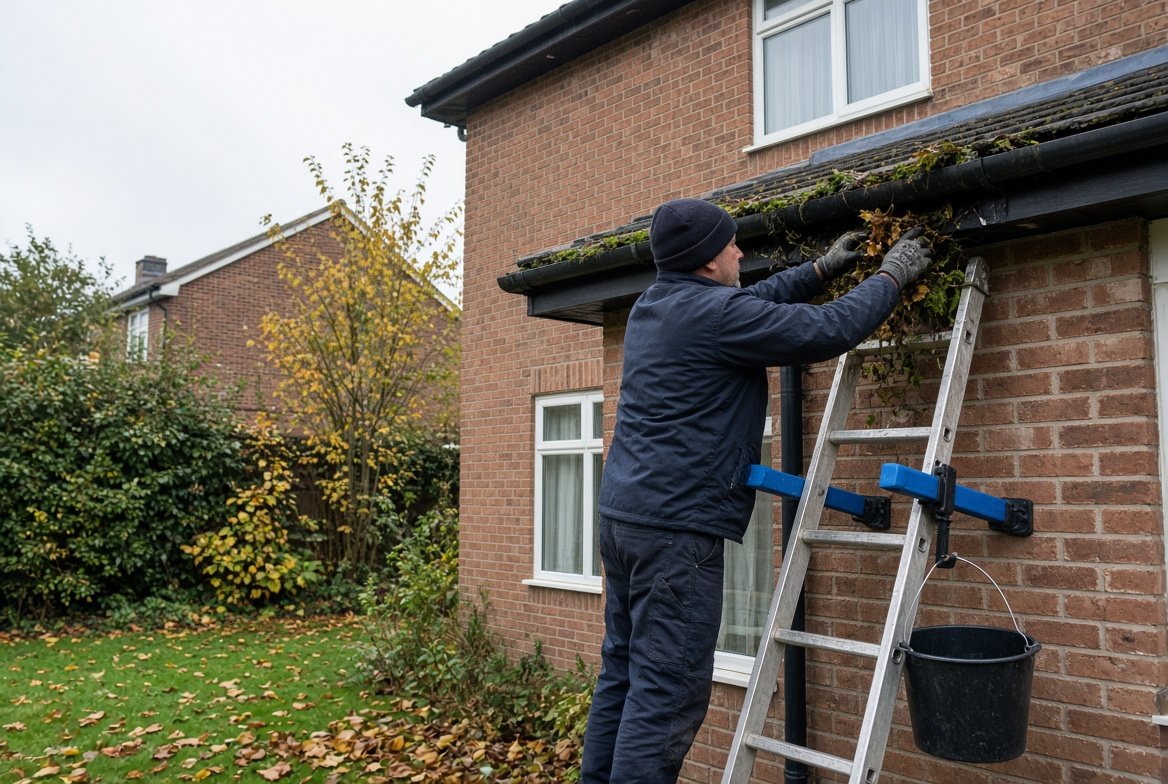
Gutters do a quiet job until the day they stop doing it. Leaves, moss, roof grit and the odd tennis ball build up over a year, and once the channel is full, rain spills over the front, runs down the wall and soaks the foundations. This guide explains how to clean gutters safely, which tools help, how often to do it, what professionals typically charge in the UK and when it is better to leave the job to someone else.
Why Gutter Cleaning Matters
A blocked gutter cannot carry water to the downpipe. The overflow can stain brickwork, encourage damp, rot the fascia and soffit timber and, in winter, freeze and add weight to the gutter until it sags or pulls away. Water that backs up can also be pushed under the edge of the roof covering, which is how a simple blockage turns into a leak inside. Clearing the channel twice a year is a small job compared with repairing the damage it prevents.
How Often Should You Clean Gutters?
As a general guide, clean gutters at least twice a year, typically in spring and again in autumn once most of the leaves have fallen. Homes near overhanging trees, in woodland areas or with a lot of moss on the roof may need extra visits. It is also worth checking after a major storm. Our guide to roof valleys and guttering shows how gutters fit into the wider drainage system and why valleys often fill with debris too.
Signs Your Gutters Need Cleaning
- Water spilling over the front of the gutter during rain.
- Water running down the wall behind or below the gutter.
- Green or black staining on brickwork under the gutter line.
- Plants, moss or even small shrubs growing in the channel.
- Sagging sections that hold standing water.
- Birds or insects nesting in the gutter.
- Damp patches inside near the external wall. If you see drips indoors, our guide to a dripping roof helps you tell a blocked gutter from other causes.
Safety First
Working at height is dangerous. Falls from ladders are one of the most common causes of serious injury in home maintenance. If your gutters are above the first floor, or you do not feel confident, use a professional with the right access equipment.
Want a number specific to your roof?
Get matched with local roofers for a free, no obligation quote.
- Position the ladder on firm, level ground at roughly a 1 in 4 angle, which means one unit out for every four units up.
- Use a ladder stand-off or stabiliser, so the ladder does not rest on the gutter itself.
- Keep three points of contact and never lean or overreach. Move the ladder instead.
- Ask someone to foot the ladder and stay nearby.
- Never clean in wet, icy or windy weather.
- Stay well away from overhead cables and satellite or aerial fittings.
- Do not climb onto the roof to reach the gutter.
Asbestos warning. Older gutters, downpipes, soffits and cement sheets may contain asbestos. If your property was built before the 2000s and the gutters are grey, brittle and heavy, do not scrub, scrape, drill or pressure wash them. Get them checked by a competent surveyor before doing anything.
Tools for Cleaning Gutters
- Strong waterproof gloves and eye protection.
- A small plastic scoop or garden trowel (metal can damage plastic and coatings).
- A bucket with a hook, or a bag, for the debris.
- A garden hose with a spray attachment.
- A flexible gutter brush or a long-handled brush.
- A telescopic pole or a gutter cleaning vacuum kit for ground-based cleaning.
- A ladder stabiliser and a stable ladder or a tower.
- Drain rods for blocked downpipes.
Gutter Cleaning Methods Compared
| Method | Best for | Pros | Cons |
|---|---|---|---|
| By hand from a ladder | Low gutters, heavy compacted debris | Thorough, you can inspect the gutter | Ladder risk, slow, messy |
| Vacuum on telescopic poles | Two storey homes, light debris | Works from the ground, quick | Less effective on wet, packed moss |
| Pole-mounted brush | Dry leaves and light silt | Low cost, no ladder for some homes | Cannot see what is left behind |
| Flushing with a hose | Final rinse and checking flow | Shows leaks and blockages | Does not remove packed debris alone |
| Professional with tower or platform | High or awkward gutters | Safest at height, quick | Costs more |
How to Clean Gutters Step by Step
- Check the weather and the ladder. Choose a dry, calm day and make sure the ladder is stable and the stand-off is fitted.
- Put on gloves and eye protection. Gutter debris can contain bird droppings and sharp objects.
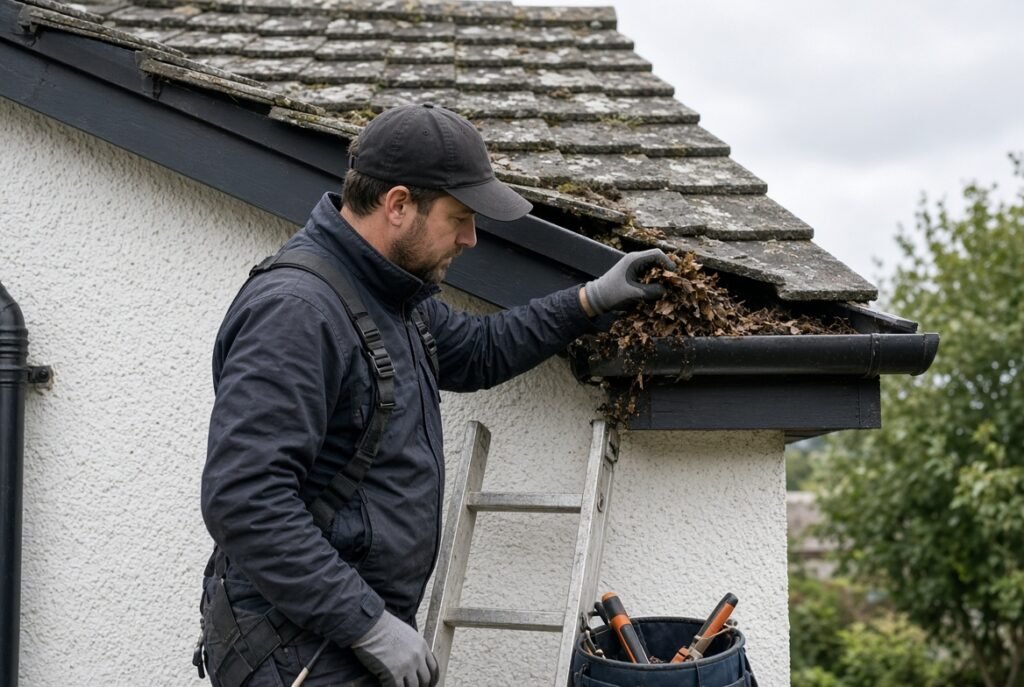
- Scoop out the loose debris. Work from the end farthest from the downpipe towards the outlet and drop the waste into a bucket or bag, not onto the ground below.
- Brush out the remaining silt. Use a soft brush so you do not scratch the coating or damage the joints.
- Flush with a hose. Start at the high end and check that water flows freely to the downpipe.
- Clear the downpipe if it is blocked. Use drain rods or a flexible tool from the bottom or the top. Do not force a rigid tool through plastic.
- Check for leaks, sagging and loose brackets. Look at each joint while water is running through.
- Dispose of the waste. Compost leaves and moss where possible, and bag anything else.
Take care around the roof edge as you work. Do not pull at tiles, flashings or trims. If you spot slipped tiles, damaged flashing or other roof problems, our guide to roof flashing shows what a failing detail looks like.
Gutter Cleaning Cost in the UK
Prices vary by region, house type, height and access, so treat these as a wide general guide only. Based on UK price guides reviewed in 2026, professional gutter cleaning commonly costs roughly £50 to £250 for a typical home, with London and the South East often at the upper end or higher.
| House type | Typical price range | Notes |
|---|---|---|
| Terraced house | About £60 to £125 | Shorter runs, usually front and back |
| Semi-detached house | About £70 to £150 | Most common property type |
| Detached house | About £90 to £230 | Longer runs and more downpipes |
| Awkward or high access | Often higher | May need a tower or platform |
Extras such as downpipe unblocking, fascia and soffit cleaning, moss removal and minor repairs can add to the bill. Ask for a written quote that lists what is included, and be wary of door-to-door callers who claim to have spotted a problem from the road. If a quote seems far from these ranges, ask why. Our guide to roof leak repair cost gives wider context if cleaning uncovers damage.
DIY or Professional?
DIY gutter cleaning suits low gutters on a stable surface if you are confident on a ladder. A professional is the better choice for high or awkward gutters, roofs with a lot of moss, houses with conservatories or porches in the way, and anyone who is unsteady, working alone or unsure about the materials. On terraced and semi-detached homes, check whether the gutter is shared or runs across a boundary, as covered in our terraced house roofs guide, before anyone works on a neighbour’s side.
When Cleaning Is Not Enough
If gutters still overflow after cleaning, look for sagging runs, loose brackets, cracked sections or leaking joints. Small leaks at joints can sometimes be sealed, but a gutter that has lost its fall, or is badly cracked, often needs adjusting or replacing. Flat roofs and some extensions drain through outlets rather than gutters, and the signs of a blockage there are covered in our roof gully guide.
Frequently Asked Questions
How often should gutters be cleaned?
At least twice a year for most homes, usually in spring and autumn. Properties near trees may need cleaning more often.
Can I clean gutters from the ground?
Yes, in some cases. Telescopic poles with a vacuum or brush attachment can clear light debris from the ground, though they are less effective on packed or wet moss.
Is it safe to use a pressure washer on gutters?
It is not recommended. Pressure washers can damage joints, coatings and seals, and they must never be used on old gutters that might contain asbestos.
How much does professional gutter cleaning cost?
As a general guide, roughly £50 to £250 for a typical UK home, depending on size, access and region, and often more in London and the South East.
What should I do if my gutter is leaking at the joints?
Clean the joint first, then check whether it can be resealed or the section replaced. If the gutter is old or sagging, replacement is often more reliable than repeated patching.
Do gutter guards remove the need for cleaning?
They can reduce the amount of debris, but they do not remove the need for checks. Silt and small seeds can still get through, so keep an eye on the gutters at least once a year.
Final Thoughts
Cleaning gutters twice a year is one of the cheapest ways to protect a home from damp and rot. Do it safely, use the right tools, and never take risks on a ladder. If the job is high, awkward or involves old materials that might contain asbestos, call a professional and get a clear written quote first.
Get a professional assessment
If you are unsure how much life your current roof has left, a local roofer can give you an honest assessment as part of a free inspection. Browse vetted roofers through our roofer directory, or get a quick replacement estimate using our free cost calculator.