
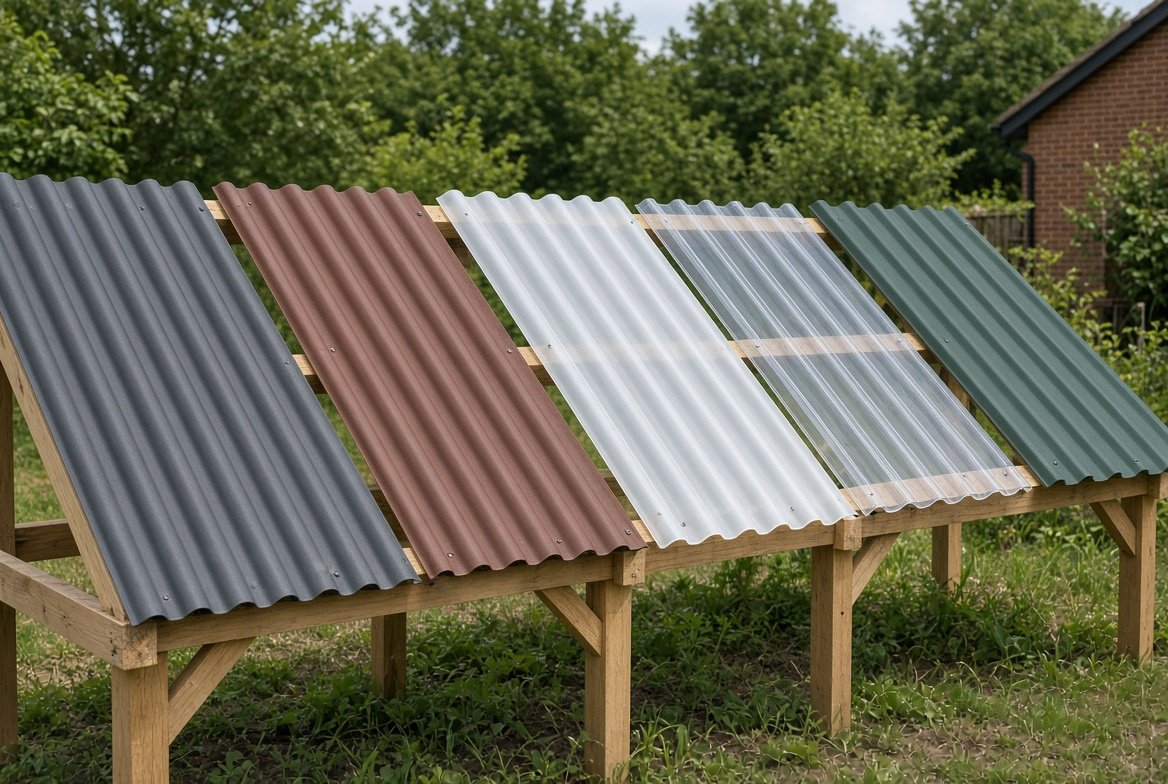
Roofing sheets cover everything from garden sheds and garages to barns, carports and industrial units. They are quicker and cheaper to fit than tiles, they are light enough for a simple frame and they come in a wide range of materials, profiles and colours. The problem is choosing between them. A steel sheet, a bitumen sheet and a clear plastic sheet may look similar in a catalogue, but they differ in lifespan, noise, insulation and the pitch they need. This guide compares the main types of roofing sheet, explains profiles and sizes and helps you choose the right one for your building.
Main Types of Roofing Sheet
| Material | Typical use | Pros | Cons |
|---|---|---|---|
| Galvanised or coated steel | Garages, barns, workshops, larger outbuildings | Strong, long spans, often 20 to 40 years or more | Noisy in rain, condensation, edges can rust |
| Aluminium | Coastal sites, lightweight structures | Light, does not rust | Dents easily, usually costs more |
| Bitumen corrugated | Sheds, log stores, small garden buildings | Quiet, light, easy to cut | Shorter lifespan, around 15 years, needs close support |
| Fibre cement | Agricultural and industrial buildings | Fire resistant, durable | Heavy, brittle, fragile, older sheets may contain asbestos |
| PVC and plastic | Lean-tos, carports, rooflights | Light, lets daylight through, low cost | Can yellow and become brittle, fragile to walk on |
| Polycarbonate | Carports, canopies, patio and conservatory roofs | Tough, insulating in multiwall, UV-protected versions | Costs more, needs correct sealing |
Steel and Metal Roofing Sheets
Steel is the standard choice for garages, workshops and farm buildings, because it spans large gaps, is strong and has a long life when well coated. It is normally galvanised and then given a factory colour finish, and it comes as corrugated or box profile sheets. Our guide to the tin roof explains laps, flashings and maintenance, and our metal roof guide compares steel with zinc, aluminium and copper. For a closer look at one lightweight option, see our guide to aluminium roofing.
Bitumen Roofing Sheets
Bitumen sheets are made from fibres soaked in bitumen, and they are popular on sheds and garden buildings because they are light, quiet and easy to cut with a saw. They need to be well supported and are generally treated as a shorter-lived option than steel. They are usually offered in brown, green, red and black.
Fibre Cement Roofing Sheets
Modern fibre cement is asbestos free and is used on agricultural and industrial buildings for its durability and fire resistance. Older sheets, installed before asbestos was banned in the UK in 1999, may contain asbestos and need careful handling. Never assume an old sheet is safe.
Want a number specific to your roof?
Get matched with local roofers for a free, no obligation quote.
Plastic and Polycarbonate Roofing Sheets
Clear and translucent sheets bring daylight into a carport, lean-to or patio. Polycarbonate is tougher and better insulated than basic PVC, while corrugated plastic is cheaper. Our polycarbonate roofing sheets guide explains thickness, pitch and sealing, and our overview of patio roof ideas shows how clear sheets compare with other outdoor roofs.
Profiles
- Corrugated: the traditional curved wave, common on sheds and barns.
- Box profile: flat-topped trapezoidal ribs that span further and have a modern look.
- Tile effect: a sheet shaped to resemble a row of tiles, often with a stone-chip finish. See our guide to lightweight and low pitch roof tiles.
- Flat and multiwall: used mainly with plastic and polycarbonate sheets.
Mixing profiles in one roof, for example opaque steel with clear plastic rooflights, requires the profiles to match, so check before you order. Our guide to corrugated roofing sheets explains how profiles match and how to count sheets.
Sizes, Thickness and Cover Width
Sizes vary between suppliers, so check the data sheet. As a general guide, steel sheets often have a cover width of around 1,000 mm and are cut to length, bitumen sheets are commonly about 2 metres by just under 1 metre, and plastic sheets often come in lengths from about 1.5 to 3.7 metres. Steel thickness is commonly around 0.5 to 0.7 mm, but check whether a coating is included in that figure. The cover width, not the overall width, is what you use when working out how many sheets you need.
Minimum Pitch
All roofing sheets need a minimum slope so water runs off and does not seep through laps. Many metal profiles are used from roughly 5 to 10 degrees, some bitumen sheets ask for a minimum fall of around 10 percent, and multiwall polycarbonate is often quoted from about 5 degrees, but these numbers differ between products. Always check the manufacturer’s figure. Our garage roof replacement guide explains the issues for flat and low-pitched outbuildings.
How to Choose the Right Roofing Sheet
- Decide how the building is used. A shed, a workshop and a carport have different needs.
- Check the roof frame and pitch. The support spacing and slope limit which sheets will work.
- Think about light. If you need daylight, choose clear or translucent sheets, or add rooflights.
- Consider noise and condensation. Steel is noisy and may drip in unheated buildings, while bitumen is quieter.
- Think about lifespan and maintenance. Coated steel lasts longest, and bitumen and basic plastic are shorter-lived.
- Set a realistic budget. Cheaper sheets cost less up front, and may need replacing sooner.
- Check the rules. Fire regulations and planning rules may limit some materials near boundaries.
Condensation, Noise and Insulation
Single-skin metal sheets are cold on the underside, so warm air in a garage or workshop can condense and drip. Anti-condensation coatings, a fleece layer, insulated panels or good ventilation reduce the problem. Rain noise is loudest on thin steel and can be reduced with insulation beneath. Habitable rooms need a roof that meets building regulations, which a single sheet does not.
Fixing and Fitting Basics
- Fix to sound purlins, rails or battens at the spacing recommended for the sheet.
- Start at the end facing away from the prevailing wind.
- Use the correct screws with sealing washers, fixed through the crests of the profile.
- Use the specified side and end laps, with sealing tape where needed.
- Allow plastic sheets room to expand by drilling oversized holes.
- Finish ridges, walls and edges with matching flashings and trims.
Safety and Asbestos
Working at height is dangerous. Roofing sheets are slippery, sharp-edged and easily caught by wind. Use roof ladders or crawling boards, wear gloves and eye protection and never work alone.
Fragile roofs. Fibre cement and plastic sheets can break underfoot, and falls through fragile roofs are a well-known cause of serious injury. Do not step directly on them.
Asbestos warning. Corrugated cement sheets installed before about 2000 may contain asbestos. Do not drill, cut, break or pressure wash them, and get them identified by a competent surveyor before any work. The HSE asbestos guidance explains the rules.
Planning and Building Rules
Replacing roof sheets like for like normally does not need planning permission in England. New outbuildings, carports and lean-tos may be covered by planning rules on height, size and use, and fire regulations may limit some materials close to a boundary. Scotland, Wales and Northern Ireland have their own systems, and listed buildings and conservation areas may have extra restrictions.
Frequently Asked Questions
What is the best roofing sheet for a shed?
Bitumen sheets are quiet and easy to fit for small sheds, while coated steel lasts longer on larger or more exposed buildings.
What is the cheapest roofing sheet?
Basic corrugated PVC and bitumen are usually the lowest-cost options, but they typically do not last as long as coated steel.
How long do roofing sheets last?
It depends on the material. As a general guide, coated steel often lasts 20 to 40 years or more, bitumen sheets about 15 years and good plastic sheets 10 to 20 years.
What is the difference between corrugated and box profile?
Corrugated sheets have a curved wave, while box profile sheets have flat-topped trapezoidal ribs that usually span further.
Can I fit roofing sheets myself?
On a simple, low roof with basic tools and the manufacturer’s instructions, yes. Larger or higher roofs are better left to a professional.
How can I tell if old sheets contain asbestos?
You often cannot tell by looking. Treat old cement sheets as suspect, do not disturb them and ask a competent surveyor to test a sample.
Final Thoughts
The right roofing sheet depends on the building, the roof pitch and how long you want it to last. Steel suits larger and longer-lived buildings, bitumen suits small sheds, and plastic and polycarbonate bring in light. Check the pitch, supports and fixing details before you buy, work safely at height and treat old cement sheets as asbestos until proven otherwise.
Get a professional assessment
If you are unsure how much life your current roof has left, a local roofer can give you an honest assessment as part of a free inspection. Browse vetted roofers through our roofer directory, or get a quick replacement estimate using our free cost calculator.