
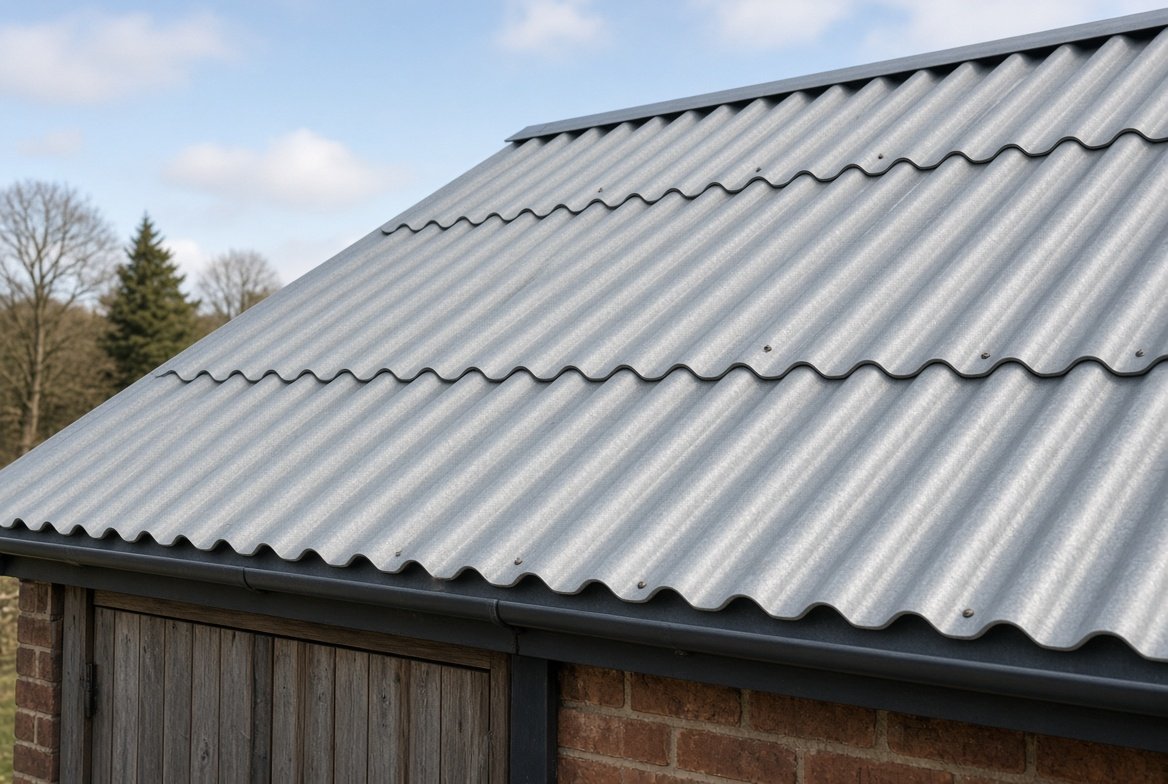
Corrugated roofing sheets are one of the quickest and cheapest ways to cover a shed, garage, carport, barn or lean-to. They are light, come in large sizes and can be fitted with basic tools. But “corrugated” covers a surprising range of products, including steel, bitumen, fibre cement and clear plastic, and each behaves differently. This guide explains the main types, how they compare, typical sheet sizes, how to work out how many you need and the basics of fitting them safely.
What Are Corrugated Roofing Sheets?
Corrugated sheets are rolled or moulded into a repeating wave. The ridges stiffen the sheet, so a thin, light panel can span between purlins or battens without sagging. A related profile, box profile, has flat-topped trapezoidal ribs instead of curved waves. Both are widely used on outbuildings, farm buildings, garages and industrial units. Our guide to the tin roof goes into detail on laps, flashings and maintenance for metal sheets.
Types of Corrugated Roofing Sheet
| Type | Typical use | Pros | Cons |
|---|---|---|---|
| Galvanised or coated steel | Barns, garages, workshops | Strong, long spans, many colours, often 20 to 40 years or more | Noisy, condensation, rust at cut edges |
| Bitumen corrugated sheets | Sheds, garden buildings, canopies | Light, quiet, easy to cut with a saw | Needs close support, often about 15 years, can sag in heat |
| Fibre cement | Agricultural and industrial buildings | Fire resistant, durable | Heavy, brittle, fragile to walk on, cutting needs dust control |
| PVC, polycarbonate and GRP | Rooflights, lean-tos, patios | Lets light through, light weight | Can yellow or become brittle, expands in heat |
Steel Corrugated and Box Profile Sheets
Steel sheets are the standard choice for larger or longer-lasting jobs. They are normally galvanised, then given a factory colour coating, and are widely available in corrugated, box profile and tile-effect shapes. Our metal roof guide compares steel with zinc, aluminium and copper. If you want the look of tiles in a lighter sheet, see our guide to lightweight and low pitch roof tiles.
Bitumen Corrugated Sheets
These are made from fibres impregnated with bitumen and are popular for sheds, log stores, garden rooms and bike shelters. They are quieter than steel in rain, but they need to be well supported, and they are generally treated as a shorter-lived option for non-habitable buildings. Many manufacturers quote guarantees of around 10 to 15 years.
Want a number specific to your roof?
Get matched with local roofers for a free, no obligation quote.
Fibre Cement Sheets
Modern fibre cement is asbestos free, but many older sheets installed before about 2000 contain asbestos. Never assume an old sheet is safe. See the safety section below.
Clear PVC, Polycarbonate and GRP Sheets
These translucent sheets are used to let light into a lean-to, carport or greenhouse-style structure, or mixed with opaque sheets as rooflights. Profiles must match the opaque sheets alongside them so that the laps fit. For patio and covered area ideas, see our guide to patio roof ideas.
Typical Sheet Sizes
Sizes vary by manufacturer and profile, so always check the supplier’s data sheet. As a general guide:
- Steel box profile and corrugated sheets: usually around 1,000 mm cover width, with some corrugated profiles covering just under 1 metre once fitted. Common thicknesses are around 0.5 to 0.7 mm. Lengths are often cut to order, up to several metres.
- Bitumen sheets: commonly around 2 metres long and 0.8 to 0.95 metres wide, about 2 to 3 mm thick, with an overlap that reduces the covered width slightly.
- PVC and clear plastic sheets: often sold in lengths from around 1.5 to 3.7 metres, with an overall width in the region of 750 to 950 mm.
- Fibre cement sheets: often supplied in lengths of a few metres, with a heavy weight that needs more than one person to handle.
How Many Sheets Do You Need?
- Measure the roof. Note the width along the eaves and the length of each slope, from eaves to ridge or top edge.
- Work out the sheet count across the roof. Divide the roof width by the sheet’s cover width, not its overall width, and round up.
- Allow for overhang. Sheets normally overhang the eaves so water drops into the gutter or clear of the wall. Check the manufacturer’s guidance.
- Allow for end laps. If the roof is longer than the sheet, include the required overlap, which is bigger at low pitches.
- Add a margin for cutting and waste. A few percent extra is a common allowance.
Minimum pitch depends on the sheet and the laps. Many metal profiles are used from roughly 5 to 10 degrees, and some bitumen sheet makers quote a minimum fall of around 10 percent, but always check the manufacturer’s figure. If you do not know your angle, our roof pitch calculator shows how to measure it.
How Corrugated Sheets Are Fitted
This is an overview only. Always follow the manufacturer’s instructions for your product.
- Check the structure. Purlins, rails or battens must be sound, level and spaced as the manufacturer specifies, because sheet thickness controls the span.
- Plan the layout. Start at the end facing away from the prevailing wind, so side laps face away from it.
- Fit the first sheet square. Let it overhang the eaves as advised, and make sure it sits straight, because mistakes carry through the whole roof.
- Fix through the crests. Use the correct screws or nails with sealing washers, usually through the crest of the wave, with extra fixings near edges and corners.
- Overlap the following sheets. Use the specified side overlap, and add sealing tape where the manufacturer asks for it.
- Finish the details. Fit ridge, barge and wall flashings, filler strips and edge trims, as explained in our guide to garage roof replacement.
Cutting and Handling Tips
- Wear gloves, eye protection and long sleeves, since sheet edges are sharp.
- Cut steel with a nibbler, shears or a fine-toothed saw, and sweep up swarf quickly, because it can rust and stain the sheet.
- Bitumen sheets can be cut with a hand saw, while plastic sheets need fine teeth and support to avoid cracking.
- Pre-drill oversized holes in plastic sheets so they can expand, and do not overtighten the screws.
- Carry sheets flat and keep them dry. Wind can catch a large sheet and cause injury.
Condensation and Noise
Metal sheets are cold and can drip with condensation in garages and workshops. Anti-condensation coatings, a fleece layer or insulated panels can reduce the problem, and ventilation helps. Rain noise on steel can be reduced with insulation beneath the sheets, while bitumen sheets are naturally quieter.
Safety and Asbestos
Working at height is dangerous. Roof sheets can be slippery and unstable. Use roof ladders or crawling boards, and secure sheets against wind as you go. Never work alone on a roof.
Fragile roofs. Fibre cement and plastic or glass-fibre rooflight sheets can break under foot, and falls through fragile roofs are a well-known cause of serious injury. Do not walk directly on them.
Asbestos warning. Corrugated fibre cement sheets fitted before about 2000 may contain asbestos. Do not drill, cut, scrub, break or pressure wash them, and get any suspect sheet identified by a competent surveyor. The HSE asbestos guidance explains the rules.
Planning and Building Rules
Replacing roof sheets like for like normally does not need planning permission in England. New outbuildings, carports and changes to listed buildings or conservation areas can be subject to rules about size, height and materials, so check with your local authority. Scotland, Wales and Northern Ireland have their own systems. Garden buildings used as habitable rooms may also trigger building regulations.
Frequently Asked Questions
What is the difference between corrugated and box profile sheets?
Corrugated sheets have a curved wave profile, while box profile sheets have flat-topped trapezoidal ribs. Box profile usually spans further between supports.
Which corrugated sheet is best for a shed?
Bitumen sheets are quiet and easy to fit on small sheds, while steel lasts longer on larger or more exposed buildings.
What size are corrugated roofing sheets?
Steel sheets typically cover around 1 metre in width and are cut to length, while bitumen sheets are commonly about 2 metres by just under 1 metre. Check each product’s data sheet.
Can I cut corrugated roofing sheets myself?
Yes, with the right tools and protective equipment. Never cut old fibre cement sheets that might contain asbestos.
Do corrugated metal roofs need insulation?
Not always, but insulation or an anti-condensation layer is recommended if the building is heated or used as a workshop, and building regulations may apply for habitable spaces.
How can I tell if my corrugated roof is asbestos?
Fibre cement sheets look similar to metal but are thicker and heavier. Do not disturb them, and get a sample tested if you are unsure.
Final Thoughts
Corrugated roofing sheets are an affordable, lightweight option when matched to the right building. Choose the material that suits the structure, check the sheet’s cover width, minimum pitch and span, and follow the fixing instructions closely. Treat old fibre cement sheets as asbestos until proven otherwise, and stay off any fragile roof.
Get a professional assessment
If you are unsure how much life your current roof has left, a local roofer can give you an honest assessment as part of a free inspection. Browse vetted roofers through our roofer directory, or get a quick replacement estimate using our free cost calculator.