
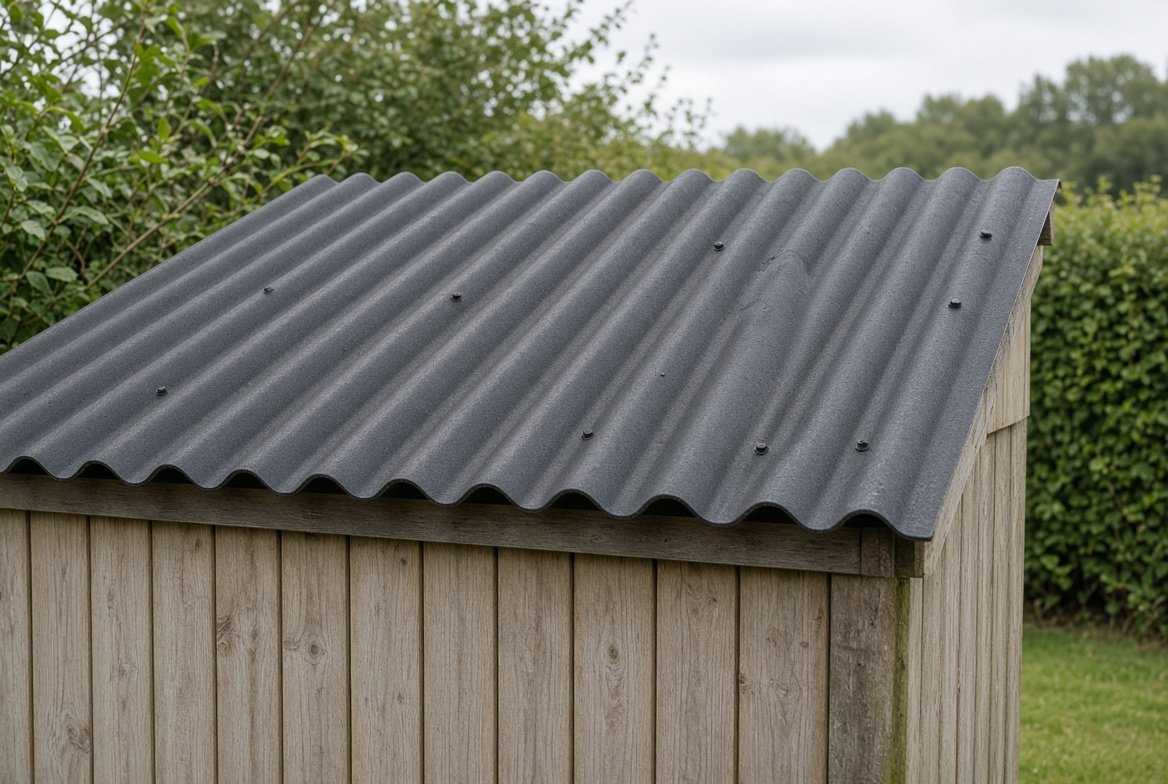
Bitumen roofing covers a surprisingly wide range of products. In everyday use, “bitumen roof sheets” usually means the lightweight corrugated sheets used on sheds, log stores and garden buildings. But bitumen is also the main ingredient in roofing felt, torch-on membranes and shingles. This guide focuses on corrugated bitumen roofing sheets, explaining what they are, how they compare with felt and other sheet materials, typical sizes, minimum pitch, fixing, lifespan and the places where they work well, and where they do not.
What Are Bitumen Roofing Sheets?
Corrugated bitumen sheets are made from organic fibres saturated with bitumen and pressed into a wave profile. They are light, easy to cut with a hand saw, naturally quiet in rain and come in colours such as black, brown, green and red. They are popular for sheds, summerhouses, log stores, bike shelters and small outbuildings where a cheap, simple roof is all that is needed. For the wider picture of sheet materials, see our overview of roofing sheets.
Bitumen Sheets, Felt, Shingles and Membranes: What Is the Difference?
| Product | What it is | Typical use | Fixing |
|---|---|---|---|
| Corrugated bitumen sheet | Rigid wave-shaped sheet, about 2 m long | Sheds, garden buildings, canopies | Nailed or screwed through the crests onto purlins |
| Bitumen roofing felt (rolls) | Flexible sheet sold in rolls | Sheds, garages, small flat roofs | Nailed or bonded onto a solid deck |
| Torch-on membrane | Reinforced bitumen layers bonded with heat | House flat roofs and extensions | Heat bonded by trained roofers |
| Bitumen (asphalt) shingles | Small overlapping tiles with a granular surface | Pitched roofs, mostly outside the UK | Nailed onto a solid deck |
For rolls of felt, see our guides to roofing felt and torch on felt roofs. If you are interested in shingles, our guide to roof shingles explains how they are used in the UK, and the guide to the asphalt roof explains the difference between mastic asphalt and asphalt shingles.
Typical Sizes
Sizes vary by manufacturer, so check the data sheet. As a general guide, corrugated bitumen sheets are commonly around 2 metres long and about 0.93 to 0.95 metres wide, about 2 to 3 mm thick, with a number of waves across the width. The useful cover width is a little less than the overall width because of the side lap. Sheets are light enough for one person to carry, but wind can catch them easily, so take care on windy days.
Want a number specific to your roof?
Get matched with local roofers for a free, no obligation quote.
Pros and Cons
Advantages
- Light and easy to handle and cut.
- Quieter in rain than steel.
- Does not rust.
- Low cost and widely available.
- Suits simple buildings and DIY projects.
Disadvantages
- Shorter lifespan than coated steel, with guarantees often around 10 to 15 years.
- Needs close support, so purlins must be spaced as the manufacturer advises.
- Colour can fade, and the sheets can soften and sag in strong heat.
- Not suitable for walking on, because the sheets are weak.
- Bitumen is flammable, so keep sheets away from stoves, flues and naked flames.
Minimum Pitch, Laps and Support
Corrugated bitumen sheets need a slope so water runs off and does not seep through the laps. A minimum fall of around 10 percent, roughly 6 degrees, is often quoted, but figures vary between products, so check the manufacturer’s information. Lower pitches need larger laps and extra sealing. Our roof pitch calculator explains how to measure your roof angle.
- Side laps: commonly one corrugation, with two at low pitch or on exposed sites.
- End laps: usually in the region of 150 mm or more, increasing on shallower roofs.
- Purlin spacing: commonly around 450 to 600 mm, and closer at low pitch or in snowy areas.
- Overhang: allow a small overhang at the eaves so water drops into the gutter or clear of the wall.
How to Fit Corrugated Bitumen Sheets
This is an overview, and the manufacturer’s instructions always come first.
- Check the frame. Purlins or battens must be sound, level and correctly spaced, with a roof slope that meets the minimum pitch.
- Plan the layout. Start at the eaves, working up the roof, and on the end facing away from the prevailing wind, so side laps face away from it.
- Stagger the sheets. Offset the joints between rows so four corners never meet at one point.
- Fix through the crests. Use the specified nails or screws with caps, following the fixing pattern in the instructions, including extra fixings at the edges.
- Overlap and seal. Use the correct side and end laps, and add sealing where the manufacturer advises.
- Finish the details. Fit ridge pieces, wall flashings and bargeboard trims, which our guide to corrugated roofing sheets also covers.
Cutting and Handling
- Cut with a fine-toothed hand saw or a jigsaw, and wear eye protection.
- Store sheets flat, off the ground and out of strong sunlight before fitting.
- Keep them dry, and avoid fitting them on very hot days, when they soften.
- Do not walk directly on the sheets. Use crawling boards that span the purlins.
Where Bitumen Sheets Work Well
- Sheds, garden buildings and log stores.
- Bike shelters and small carports with close-spaced supports.
- Animal shelters and simple outbuildings.
- Replacement roofs on small timber structures.
Where They Are Not Suitable
- Habitable rooms. They offer little insulation and need a different build-up.
- Large spans. They sag without close support.
- Near heat sources. Bitumen can soften and is combustible.
- Very low pitches. Below the minimum pitch, leaks are likely.
- Places where fire rules restrict roof materials, such as close to a boundary.
Maintenance and Repair
- Check the roof once a year for cracks, lifted laps and loose fixings.
- Brush off leaves and moss gently, and avoid pressure washing.
- Repair small cracks with a suitable bitumen sealant.
- Replace damaged sheets rather than patching them repeatedly.
- Keep gutters and the area below the roof clear.
How Long Do Bitumen Roofing Sheets Last?
Many manufacturers offer guarantees of around 10 to 15 years, and real lifespan depends on the pitch, the support, sun exposure and the quality of the sheet. They are best treated as a short-to-medium life covering for small outbuildings, with coated steel a longer-lasting alternative.
Safety and Asbestos
Working at height is dangerous. Even a low shed roof can cause injury in a fall. Use a stable ladder or platform, avoid working in wet or windy weather and never walk on sheets between purlins.
Asbestos warning. If you are replacing old roofing sheets, they may be corrugated cement that contains asbestos, which can look similar to other sheets. Do not drill, break or scrub them, and get them identified by a competent surveyor before any work. The HSE asbestos guidance explains the rules.
Rules and Permission
Replacing roof sheets like for like normally does not need planning permission in England. New outbuildings, particularly large ones or those close to a boundary, may be covered by planning and fire rules, so check with your local planning authority. Scotland, Wales and Northern Ireland have their own systems.
Frequently Asked Questions
What are bitumen roofing sheets used for?
Mainly sheds, garden buildings, log stores, bike shelters and other small outbuildings, where a cheap, light and quiet roof is needed.
How long do bitumen roof sheets last?
Guarantees are often around 10 to 15 years, though results depend on pitch, support and sun exposure.
What pitch do bitumen roof sheets need?
A minimum fall of around 10 percent, or roughly 6 degrees, is often quoted, but check the manufacturer’s figure for your product.
Can I walk on bitumen roofing sheets?
No. They are not strong enough to support a person between the purlins. Use crawling boards, and avoid stepping directly on them.
What is the difference between bitumen sheets and roofing felt?
Bitumen sheets are rigid, wave-shaped panels fixed to purlins, while felt is a flexible roll laid onto a solid deck.
Are bitumen roof sheets better than steel?
They are quieter and lighter, but steel lasts longer and spans further. Choose bitumen for small sheds and steel for bigger or longer-lived buildings.
Final Thoughts
Corrugated bitumen roofing sheets are a light, quiet and affordable way to cover a shed or small outbuilding. Check the pitch, fix the sheets through the crests with the right laps and keep purlins closely spaced. Stay off the roof when you can, keep sheets away from heat sources and treat any old cement sheets as asbestos until proven otherwise.
Get a professional assessment
If you are unsure how much life your current roof has left, a local roofer can give you an honest assessment as part of a free inspection. Browse vetted roofers through our roofer directory, or get a quick replacement estimate using our free cost calculator.