
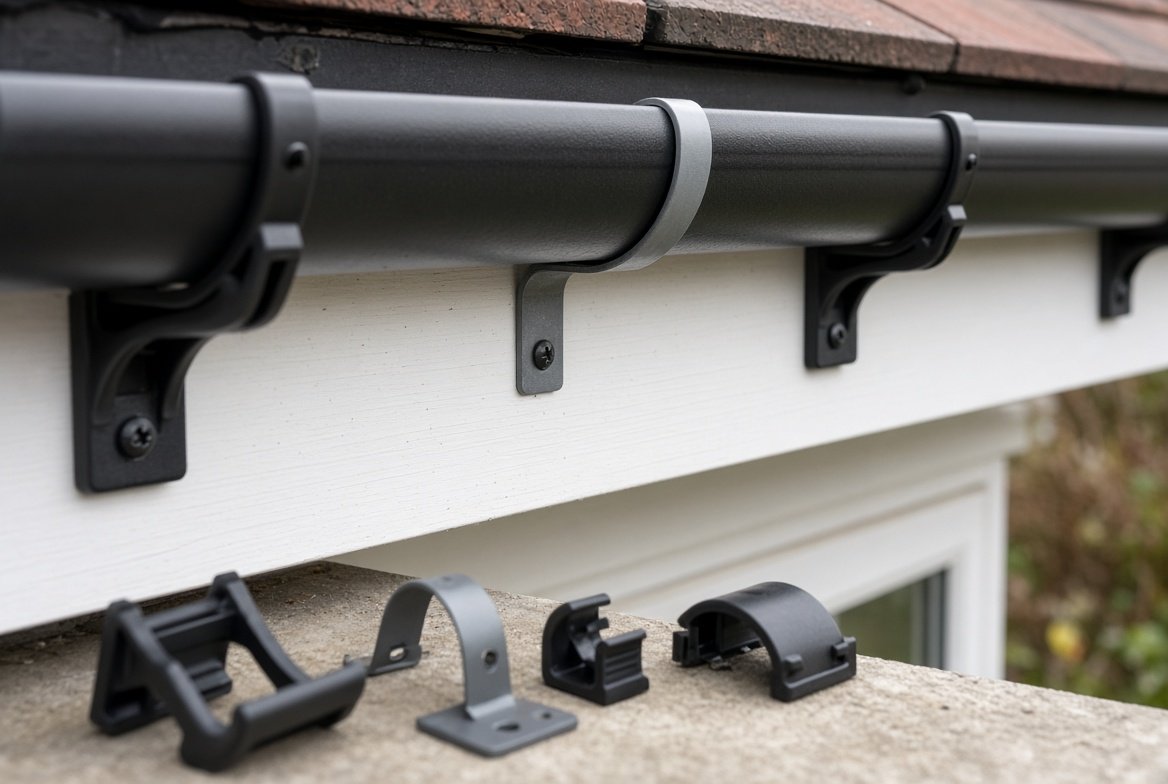
Gutter brackets are the small parts that hold the whole system up. When they fail, the gutter sags, water spills over the front and the joints start to leak. When they are fitted too far apart or screwed into weak timber, even a brand new gutter can droop within a year. This guide explains the types of gutter bracket and clip, how far apart they should be, what they fix into, how to fit or replace them and how to cure a sagging gutter without replacing the whole run.
What Do Gutter Brackets and Clips Do?
Brackets carry the weight of the gutter, including the water and any debris in it, and hold it at the right height and slope so water runs to the outlet. Clips hold parts of the gutter system together or secure the gutter to the bracket. In everyday use the words overlap, so a gutter “clip” can mean the clip that holds a joint closed, or the part of the bracket that the gutter snaps into. Both matter, because a bracket failure leads to sagging, while a failed joint clip leads to leaks. Our guide to types of guttering explains the profiles and materials the brackets must match.
Types of Gutter Bracket
| Type | Fixes to | Typical use | Notes |
|---|---|---|---|
| Fascia bracket | Front face of the fascia board | Most houses with a fascia | Must be screwed into the rafter ends or solid timber, not just thin board |
| Rafter bracket | Side or top of the rafter | Houses with no fascia or exposed rafter feet | Longer arm, set to keep the gutter at the right position |
| Rise and fall bracket | Fascia or rafter, with an adjustable arm | Setting or correcting the fall of a long run | Useful when the fascia is uneven |
| Cast iron or metal bracket | Fascia, rafter or masonry | Heavy cast iron and aluminium systems | Stronger fixing needed for the extra weight |
| Downpipe clip or holderbat | Wall | Holding downpipes to the wall | Fitted at each socket and at intervals along the pipe |
Brackets are normally profile-specific. A half round bracket will not hold an ogee or square gutter properly, and deep flow gutters often need heavier-duty brackets. Always match the bracket to the gutter system, and ideally the same manufacturer.
Gutter Clips and Joint Fittings
- Union clips: hold two lengths of gutter together at a joint, usually with a rubber seal. If the clip is cracked or the seal has perished, the joint leaks.
- Bracket clips: the part of a bracket that the gutter snaps or clips into.
- Stop ends, angles and outlets: fittings that finish the run or change direction and must be supported nearby.
- Downpipe clips: hold the pipe to the wall and should be fitted at every socket and at the intervals the manufacturer shows.
How Far Apart Should Gutter Brackets Be?
As a general guide, brackets for plastic gutters are typically fitted no more than about one metre apart, with extra brackets near joints, corners, stop ends and outlets, where the load and stress are greatest. Closer spacing is often recommended for deep flow gutters, exposed sites and areas that get snow, and heavy metal systems have their own spacing guidance. Always follow the manufacturer’s instructions, because the right spacing depends on the gutter size, material and the load the roof sheds into it.
Want a number specific to your roof?
Get matched with local roofers for a free, no obligation quote.
What Should Brackets Be Fixed Into?
A bracket is only as strong as its fixing. Screws must bite into solid timber, normally the rafter ends, behind the fascia. Thin capping boards and old, rotten fascias do not hold screws properly. If the screw heads pull through or the timber is soft, the bracket will not last. Use corrosion-resistant screws that are long enough to reach the rafter, commonly around 30 to 50 mm depending on the board. If the fascia is rotten, fix that first, as explained in our guide to fascia boards. Where there is no fascia, rafter brackets fix to the side or top of the rafter foot.
Setting the Fall
A gutter needs a slight fall towards the outlet so water drains instead of standing. The usual method is to fix the bracket nearest the outlet first, then set the brackets at the high end slightly higher, and use a string line or a spirit level to keep a straight, gradual slope between them. The exact fall is set out in the manufacturer’s instructions. At the roof edge, an eaves tray should direct water from the underlay into the gutter, so check the gutter position before fixing the brackets.
How to Fit or Replace Gutter Brackets
This is an overview, and manufacturer’s guidance always comes first.
- Set up safe access. Use a stable ladder with a stand-off, or scaffolding for higher work.
- Clear the gutter. Remove debris and silt, ideally using a method from our gutter cleaning guide.
- Check the fascia. Make sure the timber is sound and that the rafter ends are in the right place.
- Mark the line. Use a string line or spirit level to mark the bracket positions and the fall.
- Remove the old brackets. Lift the gutter slightly, release the failed bracket and take care not to crack the gutter.
- Fix the new brackets. Screw each bracket firmly into solid timber, starting at the outlet end.
- Add brackets near joints. Fit extra supports close to unions, corners and outlets.
- Refit the gutter. Clip it into the brackets and check that the joints are fully seated.
- Test with water. Run a hose slowly along the gutter and watch for drips, standing water and sagging.
How to Fix a Sagging Gutter
- Clear the gutter, because wet debris is heavy.
- Look for missing, bent or loose brackets, and tighten or replace them.
- Add extra brackets where the gutter dips, especially mid-span.
- Check that the screws are still holding in the timber, and move or replace them if the wood is soft.
- Use rise and fall brackets where the fascia is uneven.
- If the plastic is brittle or the gutter is warped, replacement may be better than adjustment.
For leaks at the joints as well as sagging, see our guide to gutter repair for resealing and gasket advice.
Common Bracket Problems
- Brackets too far apart, which makes the gutter sag between supports.
- Wrong profile, which leaves the gutter loose in the bracket.
- Short or weak screws, which pull out under load.
- Fixing into thin board or rotten fascia, which cannot hold the weight.
- Rust and corrosion, especially on cheap metal brackets and screws.
- Brittle plastic, where old brackets crack in cold weather.
- No fall, which leaves standing water that adds weight and frost damage.
Safety and Asbestos
Working at height is dangerous. Never lean a ladder on the gutter itself, and use a stabiliser or scaffolding for upper floors. Cast iron brackets and gutters are heavy, so do not attempt to lift long sections alone.
Asbestos warning. Older gutters, downpipes, soffits and fascias may be made of asbestos cement, particularly on buildings from the mid-20th century. Do not drill, cut or break them. Get any suspect material identified by a competent surveyor, and read the HSE asbestos guidance if you are unsure.
When Bracket Problems Point to a Bigger Issue
If brackets keep failing, the cause is often rotten fascia timber, a gutter that is too small for the roof or a roof valley or other detail dumping a lot of water in one place. Our guide to roof valleys and guttering explains how water concentrates at certain points and why those sections need stronger support.
Frequently Asked Questions
How far apart should gutter brackets be?
For plastic gutters, typically no more than about one metre apart, with extra brackets at joints, corners and outlets. Follow the manufacturer’s instructions for your system.
Why is my gutter sagging?
Usually missing or loose brackets, weak fixings, rotten fascia or the weight of debris. Clear the gutter and refit or add brackets.
Can I fix gutter brackets to a thin fascia?
Not reliably. Brackets need to fix into the rafter ends or solid timber. A thin capping board or rotten board will not hold them.
What are rise and fall brackets?
Adjustable brackets that let you set or correct the slope of the gutter, useful on long runs or uneven fascias.
Are gutter brackets universal?
No. Brackets are made for particular profiles and sizes, so use ones that match your gutter, ideally from the same range.
How many brackets does a gutter need?
It depends on the length and layout, but as a rough guide, one about every metre, plus extra near each joint, corner and outlet.
Final Thoughts
Gutter brackets are cheap, small and easy to overlook, but they decide whether a gutter stays level for years or sags within months. Match the bracket to the gutter, space them as the maker advises, fix them into solid timber and set a gentle fall. Work safely, and check old gutters for asbestos before touching them.
Get a professional assessment
If you are unsure how much life your current roof has left, a local roofer can give you an honest assessment as part of a free inspection. Browse vetted roofers through our roofer directory, or get a quick replacement estimate using our free cost calculator.