
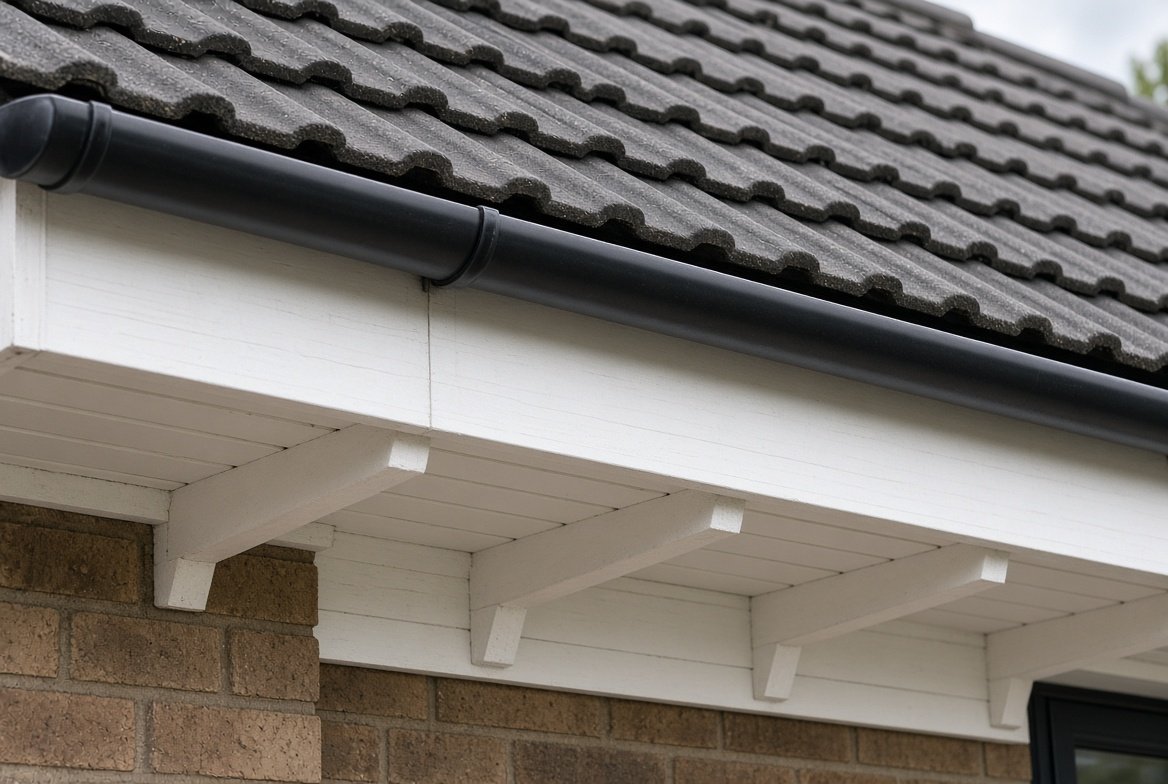
The fascia board is the long board you see running along the bottom edge of the roof, directly behind the gutter. It is easy to ignore until it rots, warps or starts to pull the gutters away from the house. This guide explains what fascia boards do, the main types, standard sizes, how the common materials compare, how to tell when a board needs replacing and what the job involves.
What Is a Fascia Board and What Does It Do?
A fascia board is fixed to the ends of the rafters along the eaves. It closes off the roof structure at the front, supports the guttering, helps hold the bottom edge of the roof covering in place and protects the timber behind from weather, birds and insects. Because it carries the weight of full gutters and sits right where rainwater runs off the roof, it is one of the first parts of the roofline to suffer if water management fails. Our guide on what eaves are shows where it sits, and our overview of the parts of a roof puts it in context.
Fascia, Soffit and Bargeboard: What Is the Difference?
- Fascia: the vertical board on the front of the rafter ends, usually carrying the gutter.
- Soffit: the horizontal board underneath the overhang, which closes the gap between the fascia and the wall and may include ventilation.
- Bargeboard (or verge board): the board that follows the sloping edge of a gable end. It does a similar job to the fascia but is not usually fitted with gutters.
Fascia and soffit boards are normally replaced together, because they are fixed to each other, but this guide concentrates on the fascia.
Types of Fascia Board
Full Replacement Fascia
A full replacement fascia is a thick board, commonly around 16 to 18 mm, that is fixed directly to the rafter ends and replaces the old board completely. It needs no timber backing and is strong enough to support gutters and the bottom edge of the roof covering. It is usually the right choice when the old fascia is rotten or damaged.
Want a number specific to your roof?
Get matched with local roofers for a free, no obligation quote.
Capping (Cover) Board
A capping board is a thinner board, commonly around 9 to 10 mm, that fits over an existing timber fascia. It is quicker to fit and keeps the original board in place, so it only suits fascia timber that is sound. If the old timber has already begun to rot, covering it can hide the problem and let the damage continue.
Profiles
Fascia boards come in flat or square edge profiles, bullnose profiles with a rounded top edge, and ogee profiles with a decorative moulded edge. Choose a profile that suits the age and style of the house, and check that your gutter brackets and fittings suit the board you choose.
Fascia Board Sizes
Widths commonly run from about 150 mm to 300 mm, with deeper boards of around 400 mm used on some roofs. Full replacement boards are often sold in 5 metre lengths, while capping boards are often 2.5 to 3 metre lengths, though this varies by manufacturer. To choose a width, measure the existing board from top to bottom, check it covers the rafter ends and allows for any soffit return, and allow for any over fascia vent or eaves tray. If you plan to change the profile or thickness, look at how it affects the gutter line before you order. Our guide to the eaves tray explains how felt and water are guided into the gutter at this point.
Fascia Materials Compared
| Material | Pros | Cons | Maintenance |
|---|---|---|---|
| uPVC | Widely available, usually the lowest-cost full replacement, many colours | Can fade or yellow over time, less traditional look | Wipe clean occasionally |
| Timber | Traditional look, suits period homes, easy to shape | Rots if water gets in and paint fails | Regular painting or staining |
| Aluminium | Does not rot, slim profiles, long-lasting finishes | Usually costs more, can dent | Low |
| Composite | Rot resistant, can mimic timber | Often higher cost, fewer profiles | Low |
uPVC is the most common choice on UK homes, and black, white, grey and woodgrain finishes are widely available. Lifespan depends on exposure and installation, so ask the supplier for guarantee details rather than relying on general figures.
Signs Your Fascia Boards Need Replacing
- Soft, crumbling or flaking timber, or paint that peels repeatedly.
- Gaps, cracks or splits along the board.
- Gutters that sag, leak or no longer hold their fall.
- Stains or damp patches on the board or the wall behind.
- Birds, wasps or insects entering behind the board.
- Warped or bowed uPVC that no longer sits flat.
If the rafter ends behind the board are rotten, they may need repair too. Our guide to roof timbers explains how to spot rot and woodworm.
Repair or Replace?
Small areas of surface rot on timber can sometimes be cut out, treated and filled, then repainted. Widespread rot, structural weakness, repeated gutter leaks or a warped board usually mean replacement. Capping over sound timber is a cheaper short-term option, but a full replacement is generally more reliable when the original board is in poor condition. Replacing the fascia is also a good time to check and renew the guttering. See our guide to types of guttering before you choose a new system, so the gutter and fascia suit each other.
How Fascia Boards Are Replaced
- Set up safe access. Use scaffolding or a proper tower, not just a ladder resting on the gutter.
- Remove the guttering. Take down gutters and brackets, and set them aside for reuse or replacement.
- Remove the old fascia. Pull off the old board and any soffit return, and check the rafter ends.
- Repair the timber. Treat or replace any rotten rafter feet and check that the ends are level.
- Fit an eaves tray or support. Make sure the roofing felt or underlay is supported and guided into the gutter.
- Fix the new board. Nail or screw it into the rafter ends, keeping a straight line and a neat joint at corners.
- Refit the guttering. Re-establish the fall and check each joint with water running through.
Where the soffit is vented, an over fascia vent may be fitted along the top of the new board so that the roof space keeps breathing. A neat trim detail at corners and ends completes the job, which our guide to roof edge trim explains.
Safety and Asbestos
Working at height is dangerous. Replacing fascia boards means working at eaves level with heavy gutters, so a scaffold is strongly advised. If you are not confident, use a qualified roofer.
Asbestos warning. Fascia boards, soffits and bargeboards on older buildings may be made of asbestos cement, particularly on properties built or altered before asbestos was banned in the UK in 1999. Do not drill, cut, scrub, sand or break them. Get them identified by a competent surveyor before any work, and read the HSE asbestos guidance.
Planning and Regulations
Replacing fascia boards like for like normally does not need planning permission in England. If the property is listed or in a conservation area, there may be rules about materials and profiles, so check with your local planning authority first. Scotland, Wales and Northern Ireland have their own planning systems.
Frequently Asked Questions
What is a fascia board?
It is the board fixed to the rafter ends along the eaves. It supports the gutters, closes the roof edge and protects the timber behind it.
What is the difference between fascia and soffit?
The fascia is the vertical board at the front of the overhang, while the soffit is the horizontal board underneath it that closes the gap to the wall.
What size fascia board do I need?
Widths commonly run from about 150 mm to 300 mm. Measure your existing board and check how it covers the rafter ends and soffit return before ordering.
Should I replace or cap my fascia boards?
Capping suits sound timber, while full replacement is better if the old boards are rotten, damaged or warped. Capping over rot can hide problems.
How long do uPVC fascia boards last?
They commonly last for decades, but the exact lifespan depends on quality, exposure and installation. Ask for the manufacturer’s guarantee.
Can I paint uPVC fascia boards?
Yes, with a paint made for uPVC and proper preparation, though many owners choose factory-coloured boards instead.
Final Thoughts
Fascia boards are a small part of the roof with a big job. Choose a material and profile that suit your home, use full replacement boards where the old timber is damaged, and fit them with a safe scaffold and a well-supported eaves detail. Check old boards for asbestos before touching them, and renew the guttering at the same time if it is near the end of its life.
Get a professional assessment
If you are unsure how much life your current roof has left, a local roofer can give you an honest assessment as part of a free inspection. Browse vetted roofers through our roofer directory, or get a quick replacement estimate using our free cost calculator.