
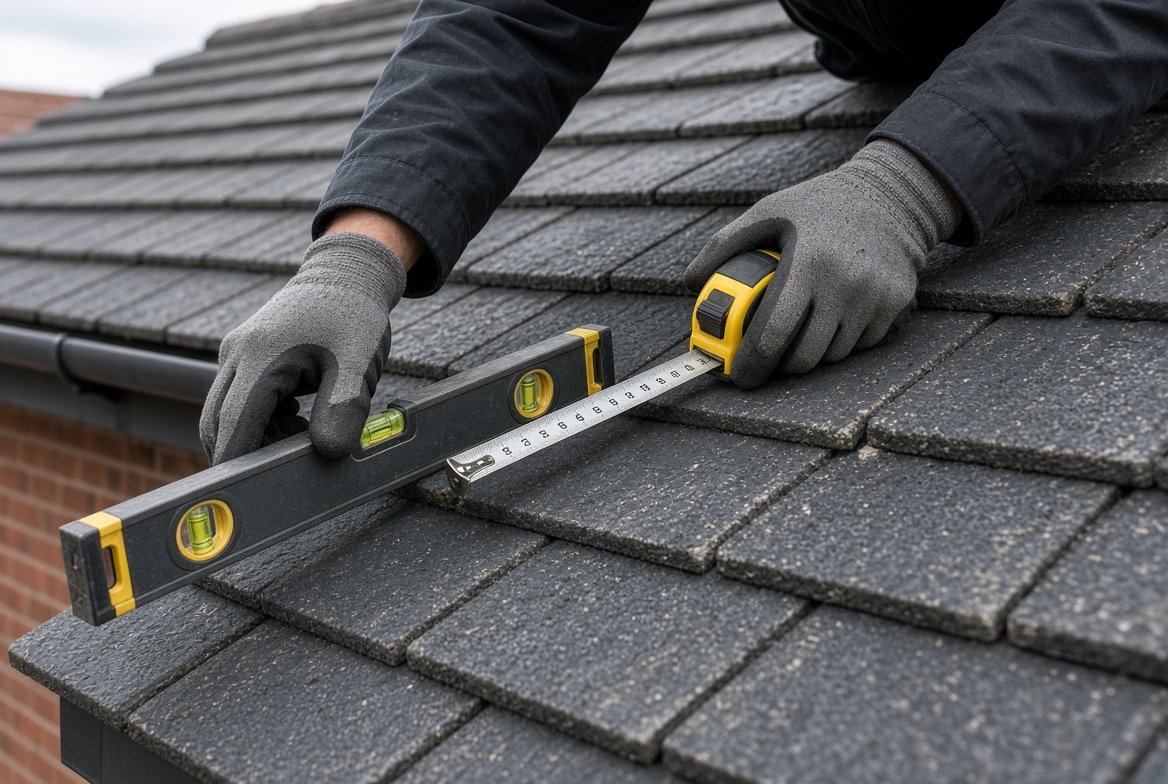
Knowing your roof pitch helps with almost every roofing decision. It decides which tiles or slates you can use, how much loft space you have, whether you can fit solar panels or a roof window, and how a roofer prices the job. The good news is that you can work out the pitch of a roof without climbing onto it.
This guide shows four ways to find the pitch of a roof, explains how to convert between degrees, ratio and percentage, and covers the mistakes to avoid. If you just want a quick answer, use our roof pitch calculator, which turns your measurements into degrees, ratio and percentage.
What Is Roof Pitch?
Roof pitch is the steepness of the roof slope. It compares the vertical rise of the roof with the horizontal run. A flat roof has a pitch of zero, and a roof that rises one metre for every metre it runs has a pitch of 45 degrees.
In the UK, pitch is usually given in degrees. You will also see it written as a ratio, such as 6 in 12, in imported products, and as a percentage on some flat roof and metal roofing products. For a wider look at how pitch affects the design, see our pitched roof guide.
Want a number specific to your roof?
Get matched with local roofers for a free, no obligation quote.
Before You Start: Rise and Run
All the methods below come down to two measurements.
- Rise: the vertical height of the roof, from the wall plate up to the ridge.
- Run: the horizontal distance from the outside wall to a point directly below the ridge. On a symmetrical roof, this is half of the width of the building.
Once you have the rise and the run in the same units, the pitch in degrees is the inverse tangent (arctan) of rise divided by run.
Method 1: Measure From the Loft (Easiest and Safest)
If you can get into the loft, this is the most accurate method and you stay off the roof.
- Hold a spirit level perfectly horizontal against the underside of a rafter, with one end touching the rafter.
- Mark a point exactly 300 mm along the level.
- Measure the vertical distance from that mark up to the rafter. This is your rise over a 300 mm run.
- Divide the rise by 300 and look up the angle, or enter both numbers into the calculator.
For example, if the vertical distance is 210 mm, then 210 divided by 300 is 0.7, which is a pitch of about 35 degrees.
Method 2: Use a Phone Inclinometer or Angle Finder
Most smartphones have a built-in level or you can download a free inclinometer app. A digital angle finder does the same job.
- Lay the phone or angle finder flat along the side of a rafter, inside the loft.
- Wait for the reading to settle and note the angle.
- Repeat on two or three other rafters and take the average.
Take care that the device sits flat along the timber. A tilted phone can easily add a degree or two to the result.
Method 3: Measure From the Ground Using the Gable End
If you cannot get into the loft, you can work out the pitch from the end wall of the house, where the roof forms a triangle. This works on a symmetrical gable roof.
- Measure the width of the house at the gable end. Half of this is the run.
- Estimate the height from the top of the wall to the ridge. This can be done from plans, with a laser measure, or by measuring from the ground to the ridge and subtracting the wall height.
- Divide the rise by the run and convert to degrees.
For example, if the house is 8 metres wide, the run is 4 metres. If the ridge is 2.8 metres above the wall plate, the rise divided by run is 0.7, which again gives a pitch of about 35 degrees.
This method is only as accurate as your height measurement, so use it for a rough figure. If you are working out a pitch for an order of tiles, double-check it from inside the loft.
Method 4: Use the Plans or Elevation Drawing
If you have the architect’s drawings, building survey or planning documents, the pitch is often written on the elevation. It might be shown as degrees, such as 35 degrees, or as a ratio. For a newer house, this is often the quickest option. For older houses, the plans may not be available, or the roof may have been altered, so confirm with a measurement.
Roof Pitch Conversion Table
| Ratio (x in 12) | Degrees | Percentage |
|---|---|---|
| 3 in 12 | 14.0° | 25% |
| 4 in 12 | 18.4° | 33% |
| 6 in 12 | 26.6° | 50% |
| 8 in 12 | 33.7° | 67% |
| 9 in 12 | 36.9° | 75% |
| 12 in 12 | 45.0° | 100% |
What Is a Normal Roof Pitch in the UK?
Most UK homes have a pitch between about 30 and 50 degrees. Older houses and those with plain clay tiles or slate tend to be steeper. Newer homes with interlocking concrete tiles are often lower, from around 22 to 35 degrees. A roof under about 10 degrees is usually treated as a flat roof.
Why Your Pitch Matters
- Roof covering. Every tile and slate has a minimum pitch. If your roof is too shallow, you may need a different product. See our guide to lightweight and low pitch roof tiles for options.
- Design and structure. The pitch affects the size of timbers and the loft space. Our guide on roof construction explains how this works.
- Single-slope roofs. Many are shallow, which is why they often use metal or special tiles. See our mono pitch roof guide.
- Solar panels, windows and quotes. Installers need to know the pitch to design the system and price the work.
Common Mistakes When Measuring Roof Pitch
- Mixing units. Rise and run must both be in millimetres, centimetres or metres, not a mix.
- Measuring along the slope instead of horizontally. The run is always horizontal, and the rise is always vertical.
- Using the full width of the house as the run. On a gable roof the run is half the width.
- Holding the level at an angle. The spirit level must be perfectly horizontal for the reading to be right.
- Measuring only once. Take two or three readings and average them, as old roofs can sag.
- Climbing onto the roof. It is not worth the risk. Use the loft or the gable end instead.
Safety Reminder
Never walk on a roof or use a ladder in poor conditions just to measure the pitch. Use the loft, the plans or the ground-based method. If you need an accurate figure for tile selection or planning, ask a roofer or surveyor to measure it.
Frequently Asked Questions
How do I work out the pitch of my roof?
Measure the vertical rise over a known horizontal run, divide rise by run and take the inverse tangent to get the angle in degrees. The easiest place to measure is from inside the loft.
How do I find my roof pitch from the ground?
Measure half the width of the gable end for the run and estimate the height from the wall top to the ridge for the rise. Divide rise by run and convert to degrees.
What is a 6 in 12 pitch in degrees?
A 6 in 12 pitch is about 26.6 degrees.
What pitch is a 35 degree roof in ratio?
A 35 degree roof is about 8.4 in 12, or a 70% slope.
What is the most common roof pitch in the UK?
Between 30 and 50 degrees, with 35 degrees being very common on older tiled houses.
Can I use a phone to measure roof pitch?
Yes, with a level or inclinometer app. Lay the phone flat along a rafter and read the angle, then repeat and average the results.
Final Thoughts
Finding your roof pitch is a quick job once you know the method. Start in the loft with a level and a tape, check the result with the calculator and keep the figure on hand when you talk to roofers or suppliers. It will save you from ordering the wrong tiles and help you spot quotes that do not add up.
Get a professional assessment
If you are unsure how much life your current roof has left, a local roofer can give you an honest assessment as part of a free inspection. Browse vetted roofers through our roofer directory, or get a quick replacement estimate using our free cost calculator.