
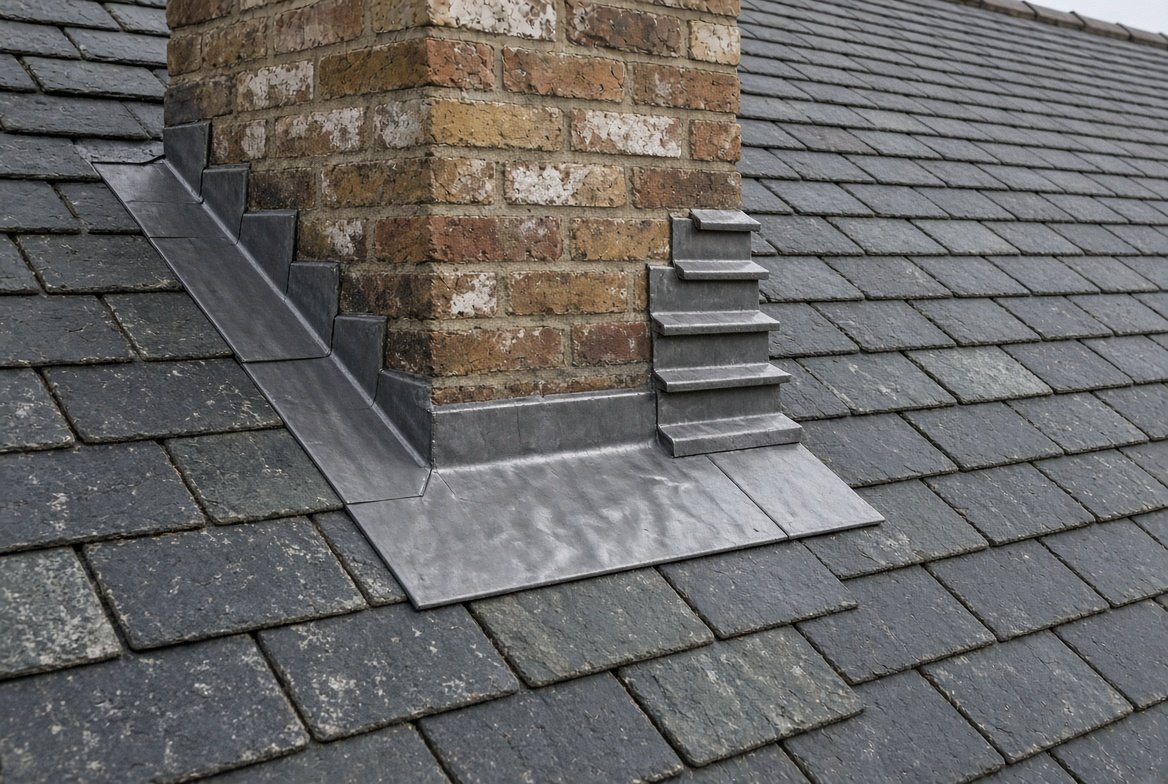
Lead flashing is the strip of lead that seals the joints where a roof meets a wall, a chimney or another roof. It has been used on British buildings for centuries, and it is still the first choice for many roofers because it is durable, easy to shape and long lasting.
This guide covers the main types of lead flashing, the lead codes, how it is fitted, how long it lasts and what commonly goes wrong. For a wider look at all flashing materials, see our roof flashing guide.
What Is Lead Flashing?
Flashing is a waterproof barrier placed at the weak points of a roof. These are the places where two surfaces meet and a simple overlap of tiles cannot keep water out. Lead is a popular choice because it is soft enough to be dressed tightly into awkward shapes, and it does not rust.
Lead flashing is normally supplied as sheet or as a roll. Roofers cut it to length, shape it by hand and fix it so that water runs over it and away from the joint.
Want a number specific to your roof?
Get matched with local roofers for a free, no obligation quote.
Where Lead Flashing Is Used
- Chimneys: around the base of the stack, including the back gutter and side flashings.
- Abutments: where a sloping roof meets a wall, such as on an extension or a dormer.
- Roof valleys: where two roof slopes meet at an internal angle.
- Ridges and hips: as capping on some traditional and slate roofs.
- Skylights and roof windows: around the frame, if the manufacturer’s flashing kit is not used.
- Flat roof edges: where a flat roof meets a wall, as an upstand cover.
Types of Lead Flashing
Step Flashing
Used where a pitched roof meets a wall that rises above it, such as the side of a chimney or the party wall of a terraced house. The lead is cut or folded into a stepped shape that follows the brick courses, with each step tucked into a mortar joint.
Apron Flashing
A single flat piece of lead fitted along the lower edge of a chimney or wall. It sits over the tiles and sheds water onto the roof below.
Cover Flashing
A strip dressed over an upstand, for example where a flat roof covering turns up a wall. The cover flashing overlaps the upstand and protects its top edge.
Back Gutter
A lead channel at the high side of a chimney that directs water around it. It is one of the most common leak points on a roof, so it needs careful detailing.
Soakers
Small pieces of lead that are bent and slotted in between tiles or slates alongside a wall, then covered by a step flashing. They are used mostly on traditional slate and plain tile roofs. If you have a slate roof, see our slate roof guide for how these details fit in.
Lead Valleys
A continuous strip of lead laid in the valley where two roof slopes meet. Because valleys carry a lot of water, a lead valley needs the right thickness and a secure fixing. Our article on roof valleys and guttering explains how they are built.
Lead Codes Explained
Lead sheet is sold by code, from Code 3 to Code 8. A higher code means thicker lead. Each code is also colour-marked on the roll, which makes it easy to check you have been given the right one.
| Lead code | Colour | Thickness | Typical use |
|---|---|---|---|
| Code 3 | Green | 1.32 mm | Soakers, small details |
| Code 4 | Blue | 1.80 mm | Flashings, soakers |
| Code 5 | Red | 2.24 mm | Flashings, aprons, small valleys |
| Code 6 | Black | 2.65 mm | Valleys, gutters, back gutters |
| Code 7 | White | 3.15 mm | Gutters, flat roofs |
| Code 8 | Orange | 3.55 mm | Flat roofs, heavy-duty work |
The table is a general guide. The right code depends on the detail, the length of the run and the exposure of the building. The Lead Sheet Association publishes the industry guidance that most roofers follow, so ask your contractor which code they plan to use and why.
How Lead Flashing Is Fitted
A good installation follows a few basic rules. These are the main points to look for in a quote or on site:
- Cut a chase. For step and cover flashings, a groove is cut into the mortar joint so the top edge of the lead can sit inside it.
- Fix the top edge. The lead is held in the chase with lead wedges, then sealed with mortar or a suitable sealant.
- Dress the lead. The sheet is shaped by hand so it sits tightly over the tiles or upstand without stretching or tearing.
- Allow for movement. Lead expands and contracts with temperature. Long runs are broken into shorter lengths, commonly around 1.5 m, with generous overlaps.
- Secure the bottom edge. Lead clips hold the lower edge against the wind, so it does not lift.
Never rely on sealant alone. Mastic can look neat on the day, but it cracks and shrinks within a few years, and the leak that follows is often blamed on the lead.
How Long Does Lead Flashing Last?
Properly fitted lead flashing can last for decades, and 60 years or more is realistic on a well-built roof. The lead itself rarely wears out. When it fails, it is usually because of poor fitting, cracked pointing around the chase, or damage from movement and foot traffic.
Lead forms a pale grey-white coating after a few months outdoors. This is normal and actually protects the metal underneath, so it does not need to be removed or painted.
Lead Flashing vs Alternatives
- Lead: long-lasting and easy to shape. The drawbacks are higher cost, weight and the risk of theft in some areas.
- Aluminium and zinc: lighter and cheaper, but less forgiving to work and more likely to need replacing sooner.
- Self-adhesive flashing tape: quick to apply and sometimes used for emergency repairs. It does not have the life of lead and is not recommended as a permanent fix on a chimney or abutment.
- Cement fillets: a mortar slope sealing the joint. Common on older repairs, but prone to cracking.
Common Lead Flashing Problems
- Lifted or slipped lead: usually caused by missing clips or wedges, and often worse after high winds.
- Cracked or missing pointing: the mortar holding the top edge can crumble over time, letting water behind the lead.
- Splits and tears: caused by thermal movement when runs are too long, or by the wrong lead thickness.
- Holes and pinprick corrosion: can come from contact with fresh cement or acidic timber, and from bird droppings.
- Stolen lead: lead theft is a known problem. Check your home insurance and ask a roofer about alternatives or security options if you live in an affected area.
If you can see damp stains on a ceiling near a chimney or wall, the flashing is one of the first places to check. Our guide to fixing a leaking roof shows you how to trace the source before you call anyone out.
Is Lead Flashing a DIY Job?
Replacing lead flashing takes skill. Cutting chases, dressing lead into corners and judging the right overlaps all take practice, and the work is done at height, which carries real risk. Lead is also toxic if the dust or offcuts are handled carelessly, so wash your hands and dispose of waste properly.
If the job involves a chimney or a steep roof, hire a qualified roofer who has lead work experience. Ask to see photos of previous work and confirm which lead code they will use.
Frequently Asked Questions
What is lead flashing used for?
It seals the joints where a roof meets a wall, a chimney or another roof, so water cannot get in. It is used around chimneys, abutments, valleys and dormers.
What lead code is used for flashing?
Code 4 and Code 5 are the most common for flashings and aprons. Valleys and gutters usually need a thicker code such as Code 6.
How long does lead flashing last?
Well-fitted lead flashing can last 60 years or more. Most failures come from poor installation, failed pointing or movement, rather than the lead wearing out.
Can I use flashing tape instead of lead?
Flashing tape is fine for an emergency or a temporary repair. For a lasting repair on a chimney or wall abutment, lead or another proper metal flashing is the better choice.
Why is my lead flashing leaking?
Common causes are lifted lead, cracked pointing at the top edge, splits caused by movement, or sealant that has failed. A roofer can usually find the cause with a close inspection.
Final Thoughts
Lead flashing remains one of the most dependable ways to keep a roof watertight at its weakest points. Choosing the right lead code, fitting it properly and leaving sealant as a backup rather than the main defence will give you a repair that lasts decades. If you spot lifted, split or loose lead, deal with it early, before a small gap turns into damp inside the house.
Get a professional assessment
If you are unsure how much life your current roof has left, a local roofer can give you an honest assessment as part of a free inspection. Browse vetted roofers through our roofer directory, or get a quick replacement estimate using our free cost calculator.