
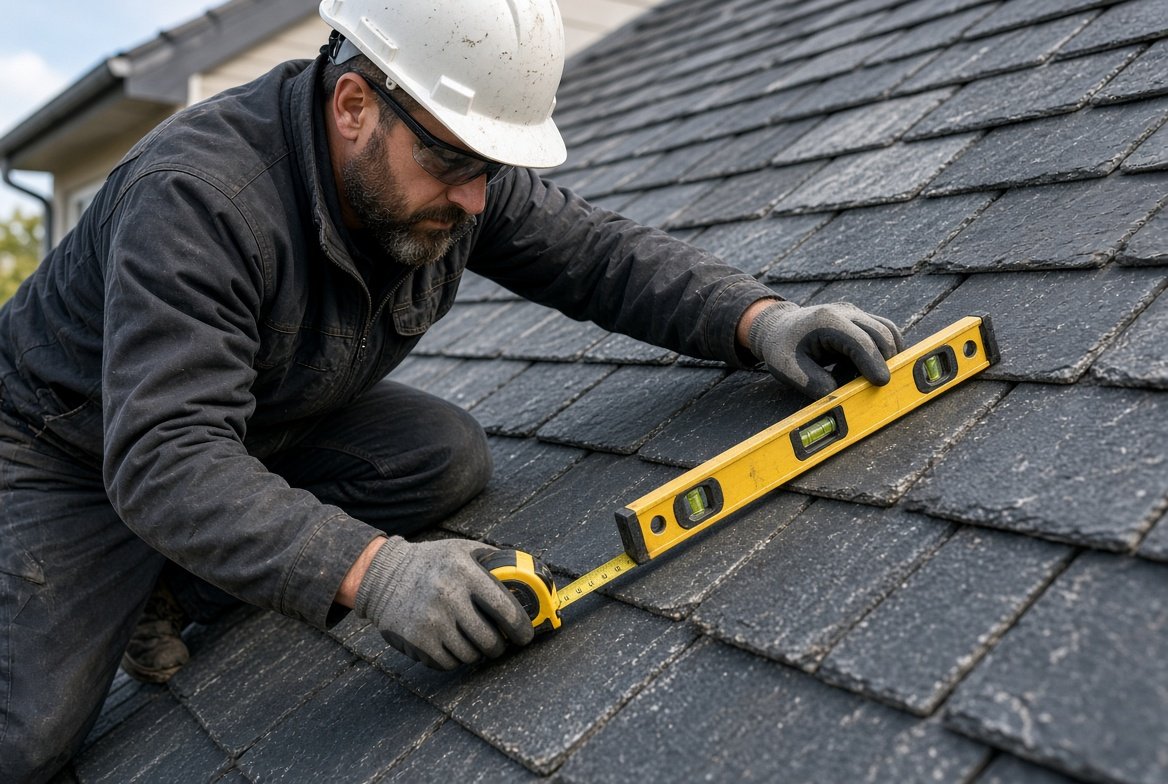
Roof pitch is the steepness of a roof. It tells you how much the roof rises for every unit it runs horizontally. It affects which tiles or slates you can use, how well the roof sheds water, how much usable loft space you get, and even how much a new roof will cost.
This guide includes a free roof pitch calculator, a step-by-step method for measuring your own roof, and a conversion table so you can switch between degrees, ratio and percentage.
Roof Pitch Calculator
Enter the rise and the run in the same units (millimetres, inches, anything), and the calculator gives you the pitch as an angle, a ratio and a percentage.
Want a number specific to your roof?
Get matched with local roofers for a free, no obligation quote.
What Is Roof Pitch?
Pitch describes the angle of a roof slope compared with the horizontal. A flat surface has a pitch of zero. A roof that rises 1 metre for every 1 metre it runs has a pitch of 45 degrees.
In the UK, pitch is almost always given in degrees, for example “a 35 degree roof”. You will also see it written as a ratio, such as 6 in 12, especially in imported products and US-based guides. Some flat roof and metal roofing products use percentage instead.
How to Calculate Roof Pitch
The formula is simple:
- Pitch in degrees = the inverse tangent (arctan) of rise divided by run.
- Ratio = rise divided by run, multiplied by 12 (this gives the “x in 12” figure).
- Percentage = rise divided by run, multiplied by 100.
For example, if a roof rises 300 mm over a run of 600 mm, the rise divided by run is 0.5. That gives a pitch of about 26.6 degrees, a ratio of 6 in 12 and a slope of 50%.
Roof Rafter Length From Pitch
Once you know the pitch, you can estimate the length of the sloping rafter. Divide the horizontal run by the cosine of the pitch angle. For a 4 m run at 35 degrees, the rafter is about 4.88 m long. This figure does not include any overhang at the eaves, which you need to add separately.
How to Measure Roof Pitch
You do not need to climb onto the roof. The safest place to measure is from inside the loft.
Method 1: Spirit Level and Tape (From the Loft)
- Hold a spirit level perfectly horizontal with one end touching the underside of a rafter.
- Mark a point 300 mm along the level, measured from the rafter.
- Measure the vertical distance from that mark up to the rafter. This is your rise over a 300 mm run.
- Enter both numbers into the calculator above.
Method 2: Phone Inclinometer or Digital Angle Finder
Lay a phone with a level or inclinometer app along the side of a rafter, or use a digital angle finder. The reading gives you the pitch in degrees straight away. Check the reading twice and take the average, because small movements can change the result.
Method 3: From the Plans
If you have architect’s drawings or a survey, the pitch is normally written on the elevation drawing. This is often the quickest option when you are planning a new build or an extension.
Never climb onto a roof to measure it unless you are trained and have the right safety equipment. Falls from roofs are one of the most common causes of serious injury in home maintenance.
Roof Pitch Conversion Table
Use this table to convert between degrees, ratio and percentage. The final column shows how much a roof rises over each metre of horizontal run.
| Degrees | Ratio (x in 12) | Percentage | Rise per 1 m run |
|---|---|---|---|
| 15° | 3.2 in 12 | 26.8% | 268 mm |
| 20° | 4.4 in 12 | 36.4% | 364 mm |
| 25° | 5.6 in 12 | 46.6% | 466 mm |
| 30° | 6.9 in 12 | 57.7% | 577 mm |
| 35° | 8.4 in 12 | 70.0% | 700 mm |
| 40° | 10.1 in 12 | 83.9% | 839 mm |
| 45° | 12 in 12 | 100% | 1000 mm |
Common Roof Pitches in the UK
Most UK homes have a pitch somewhere between 30 and 45 degrees. Older houses and those with plain clay tiles or slate tend to be steeper. Newer houses built with interlocking concrete tiles often have lower pitches, commonly around 22 to 35 degrees.
Different roof shapes tend to use different pitches. A pitched roof is the general term for any sloping roof. A hip roof is often built at a moderate pitch, which you can read more about in our hip roof guide. Roofs under about 10 degrees are usually treated as flat roofs, and they need a completely different type of waterproof covering. See our flat roof guide if your roof falls into that category.
Minimum Pitch for Roof Tiles and Slates
Every roof covering has a minimum pitch. Below it, rain can be driven under the tiles, especially in wind. As a rough guide:
- Plain clay or concrete tiles: usually need a steeper roof, commonly around 35 degrees, though some products allow slightly lower with the right underlay.
- Interlocking concrete tiles: can often go much lower, with some products rated down to roughly 15 degrees.
- Natural slate: typically needs a minimum of around 20 to 25 degrees, depending on the slate size and the exposure of the site.
These figures are only a guide. Always check the manufacturer’s minimum pitch for the exact product, and remember that exposed or high-rainfall locations may need a steeper pitch or a higher-specification underlay. You can compare materials in our guide to the types of roof tiles and our slate roof guide.
Why Roof Pitch Matters
- Water and snow shedding: steeper roofs clear rain and snow faster, which reduces the risk of leaks.
- Choice of covering: pitch decides which tiles, slates or membranes you can legally and safely use.
- Loft space: a steeper pitch gives more headroom, which matters for loft conversions.
- Cost: steeper roofs have more surface area and are harder to work on, so they usually cost more to re-cover.
- Wind performance: very steep or very shallow roofs can be more exposed to wind forces.
Frequently Asked Questions
How do I work out the pitch of my roof?
Measure the vertical rise over a known horizontal run, then divide rise by run and take the arctan to get the angle in degrees. The calculator above does this for you.
What is a 6 in 12 roof pitch in degrees?
A 6 in 12 pitch is about 26.6 degrees.
What is the most common roof pitch in the UK?
Most UK homes sit between 30 and 50 degrees, with 35 degrees being a very common figure on older tiled houses.
What roof pitch is considered flat?
Roofs with a pitch below about 10 degrees are usually treated as flat roofs and need a continuous waterproof covering rather than tiles.
Can I use roof tiles on a low-pitch roof?
Only if the tile is rated for that pitch. Many interlocking tiles work at low pitches, but plain tiles and slates generally need a steeper roof. Always check the manufacturer’s minimum pitch.
Final Thoughts
Knowing your roof pitch makes everything easier, from choosing the right tiles to getting accurate quotes. Measure it twice, use the calculator to double-check your figures, and always confirm the minimum pitch for any covering before you order materials.
Get a professional assessment
If you are unsure how much life your current roof has left, a local roofer can give you an honest assessment as part of a free inspection. Browse vetted roofers through our roofer directory, or get a quick replacement estimate using our free cost calculator.