
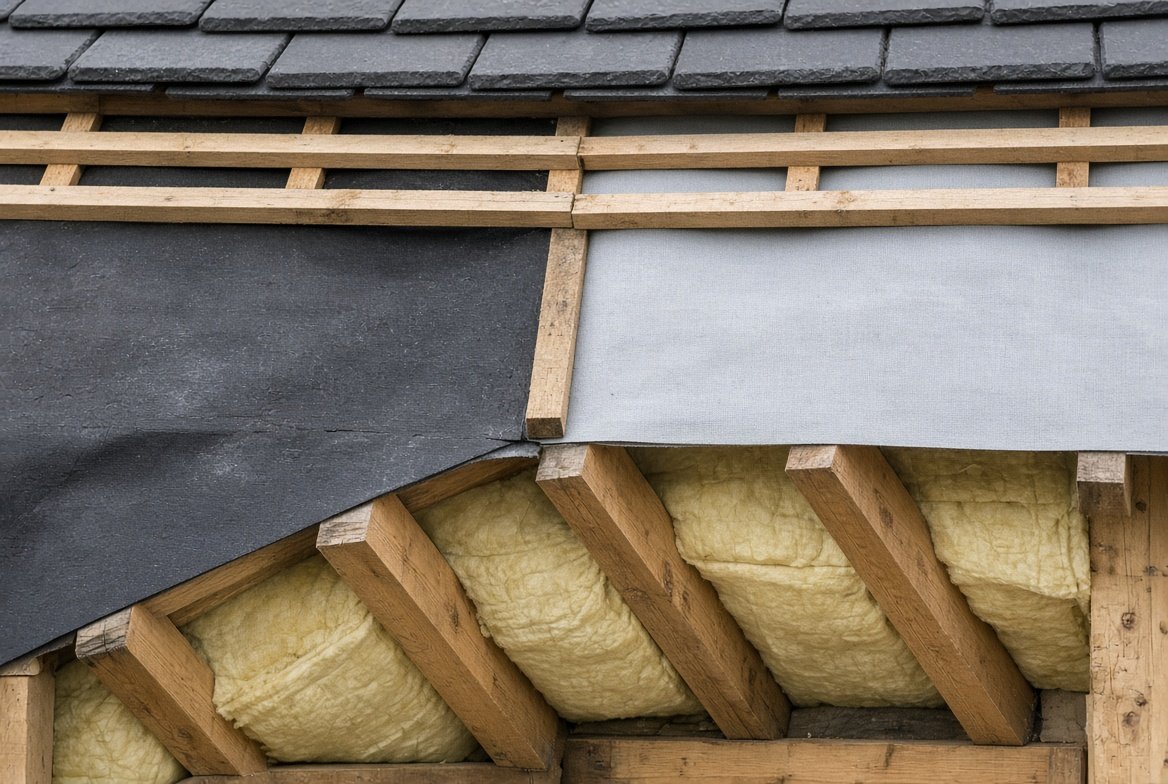
Underlay sits beneath every tile or slate on a pitched roof, and most homeowners never see it or think about it until something goes wrong. It is a genuinely important layer, acting as a second line of defence against wind-driven rain and snow that gets past the roof covering itself, and the type used affects ventilation needs, lifespan, and even building regulations compliance.
What underlay actually does
Tiles and slates shed the vast majority of rainwater on their own, but wind-driven rain, fine snow, and dust can still get past the gaps between them, particularly in exposed locations. Underlay, fitted directly onto the rafters underneath, catches whatever gets through and channels it down toward the eaves, keeping it away from the timber structure and insulation below.
The two main underlay types
UK roofing standards recognise two broad categories, referred to as high resistance and low resistance underlays.
- High resistance (HR), or non-breathable felt. The traditional bitumen felt used for decades. It acts as a complete barrier, which means it does not let moisture vapour pass through it at all, so the roof space needs proper ventilation, typically at the eaves and ridge, to stop condensation building up underneath it.
- Low resistance (LR), or breathable membrane. A lightweight, vapour permeable membrane that has largely replaced bitumen felt as the standard choice on new builds and re-roofs since the early 2000s. Its micro-porous structure lets moisture vapour escape from the roof space while still blocking wind-driven rain and snow.
Why breathable membranes became the default
Breathable membranes reduce the risk of condensation forming against cold roof timbers, which is one of the more common hidden causes of rot and structural decay in a roof. This matters more than it used to, since modern homes are generally built tighter, with better sealed windows and doors, meaning less accidental ventilation happens by chance than in older properties. That said, a breathable membrane does not remove the need for ventilation entirely. Most pitched roofs still need eaves and ridge ventilation to fully comply with building regulations and manage any residual moisture, a point covered under British Standard BS 5250, the code of practice for managing moisture in buildings.
Want a number specific to your roof?
Get matched with local roofers for a free, no obligation quote.
Wind uplift and installation standards
Underlay is also subject to wind uplift, the same force that can lift tiles in high wind. British Standard BS 5534 sets out how underlay should be tested and installed to resist this, including limits on how much a membrane is allowed to sag or balloon between rafters. Some installations need counter-battens fitted over the membrane, running with our roof battens, to provide extra support and meet current standards, which is a detail worth confirming with a roofer rather than assuming.
Common installation mistakes
- Incorrect lap spacing. Membranes and felt sheets must overlap correctly at each row to shed water effectively, and a small gap can let rain straight through
- Poor detailing around penetrations. Chimneys, roof windows, and vent pipes are common places where underlay is not properly sealed, and this is often where leaks actually start
- Sagging between rafters. If the membrane is fitted too loosely, water can pool in the resulting dips rather than draining away, sometimes leading to leaks that only appear well after the roof has been finished
When underlay gets replaced
Underlay is rarely replaced on its own, since reaching it means removing the tiles or slates above it. In practice, it is almost always replaced as part of a full re-roof. If your roof is already over 25 years old and other repair work is being done, replacing the underlay at the same time is usually more cost effective than dealing with it separately later. Signs it may be failing include damp patches on the underside of the felt visible from the loft, sagging sections between rafters, or brittle, cracking material on an older bitumen felt roof. Our guide to fixing a leaking roof covers how to tell a genuine leak apart from simple condensation.
Frequently asked questions
Is breathable membrane better than felt for a roof?
For most modern re-roofs, yes. Breathable membrane reduces the risk of condensation against cold roof timbers and is now the standard choice, though it still needs proper ventilation alongside it to fully meet building regulations.
Do I need to replace my roof underlay if I am just replacing a few tiles?
Not usually. Underlay is generally only replaced during a full re-roof, since accessing it means removing the tiles above. Small, localised repairs are sometimes possible but tend to be a short-term measure.
Can old bitumen felt still be used on a new roof?
It can still meet current standards if properly ventilated, but breathable membrane is now the default choice on new construction, according to UK building regulations guidance, largely because it manages moisture more effectively.
How long does roofing underlay last?
Properly installed and protected by the roof covering above it, breathable membrane can last for several decades, though prolonged UV exposure, poor fixing, or physical damage can shorten this considerably.
This guide is independent editorial content. It is not sponsored.
Get a professional assessment
If you are unsure how much life your current roof has left, a local roofer can give you an honest assessment as part of a free inspection. Browse vetted roofers through our roofer directory, or get a quick replacement estimate using our free cost calculator.