
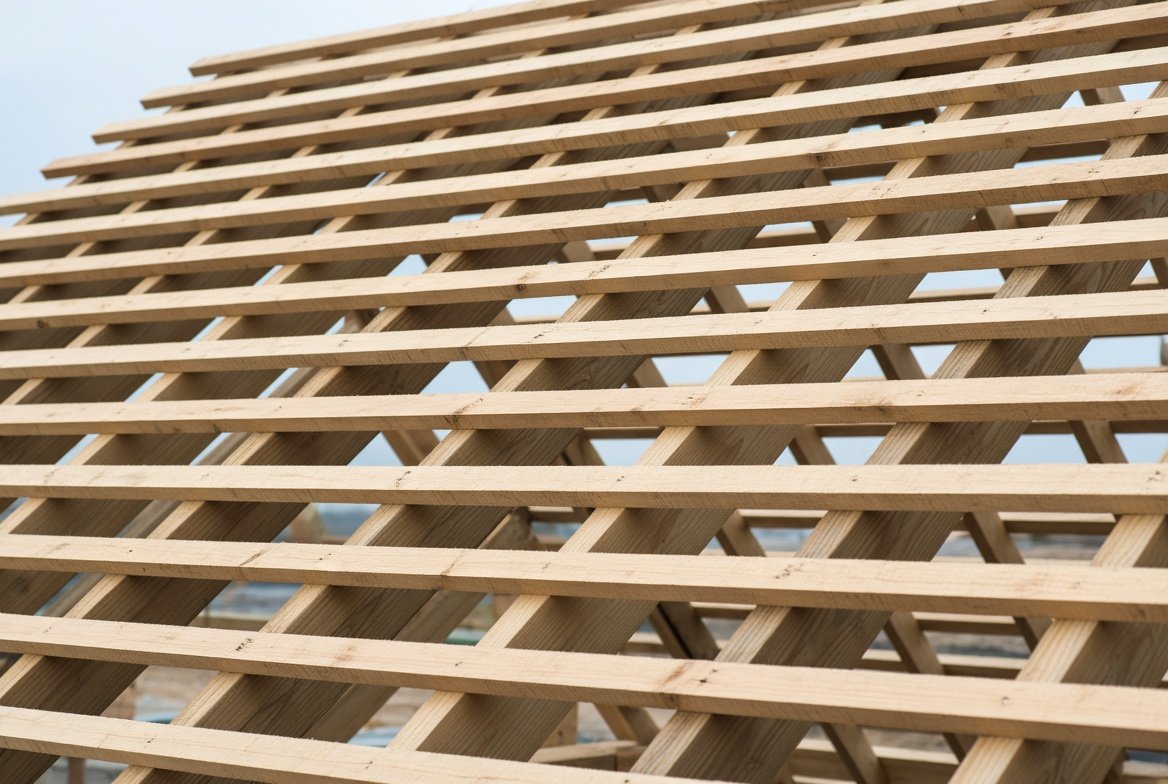
Roof battens do not get much attention, since they are completely hidden once tiles or slates go on top. But they carry the entire weight of the roof covering and hold every tile in place, which makes them one of the most important components a homeowner never actually sees.
What roof battens are
Battens are horizontal strips of treated timber fixed across the rafters of a pitched roof. Tiles or slates hang directly from them, row by row, working up from the eaves to the ridge. Without properly sized and spaced battens, even good quality tiles will not sit correctly or perform as intended.
Standard batten sizes
Batten size depends mainly on how far apart the rafters underneath are spaced.
| Rafter spacing | Typical batten size |
|---|---|
| Up to 450 to 600mm | 25 x 38mm |
| Up to 600 to 750mm | 25 x 50mm |
Battens should also span across at least three rafters at once, generally meaning a minimum length of around 1.2 metres, so that the load is shared properly rather than resting on a single point.
Want a number specific to your roof?
Get matched with local roofers for a free, no obligation quote.
Why battens must be graded, not just any timber
This is the part homeowners most often get caught out by. Roofing battens in the UK must be graded to British Standard BS 5534, meaning they have been tested for strength, durability, and moisture resistance, and are marked with a blue certification stamp to prove it. Ordinary, ungraded timber is not an acceptable substitute, even if it looks similar and is cheaper.
The consequences of skipping this are more serious than they might sound. Tile manufacturers can void their product warranty if their tiles are fitted on ungraded battens, and in some cases insurance claims can be affected too. Since battens sit underneath every single tile on the roof, discovering non-compliant battens after installation usually means stripping the whole roof covering to fix it, which is an expensive mistake to make for the sake of a relatively cheap material.
Understanding batten gauge
The gauge is the spacing between battens, measured centre to centre, and it is set by the specific tile or slate being used rather than being a fixed universal number. Each tile manufacturer publishes a maximum gauge on their product data sheet, based on how much the tiles need to overlap each other to stay watertight.
As a simplified example, if a tile is 420mm long and needs a 75mm overlap with the tile below it, the batten gauge works out to 345mm. Getting this spacing even and consistent across the roof also matters for appearance, since uneven battens can throw tile alignment visibly out of line.
How battens are installed
- Battens are nailed to the centre of each rafter, not off to one side
- Any joints between battens should land directly over a rafter, cut square and tightly butted
- Joints are staggered across rows rather than lining up, which keeps the structure stronger overall
- The final batten near the ridge is positioned so ridge tiles overlap the top course by at least 75mm
What can go wrong
- Ungraded or damaged battens. The most common and most costly mistake, sometimes only discovered during a building control inspection
- Incorrect gauge. Battens spaced too far apart for the tile being used can leave insufficient overlap, risking water getting underneath
- Rot or decay over time. Even treated battens can eventually degrade if the roof space is poorly ventilated and consistently damp
If you are getting quotes for re-roofing work, it is a fair question to ask whether the roofer plans to use BS 5534 graded battens as standard. Our guide on reading a roofing quote covers other questions worth asking before you commit to any quote.
Frequently asked questions
What size battens do I need for my roof?
It depends on your rafter spacing and the tile being used. As a general guide, 25 x 38mm battens suit rafters up to around 450 to 600mm apart, while 25 x 50mm battens are used for wider spacing, though a roofer should confirm the exact specification for your roof.
Why are graded battens more expensive than ordinary timber?
They cost more because they have been tested and certified to a recognised standard for strength and durability. Given how cheap battens are relative to the rest of a re-roofing job, this small extra cost protects a much larger investment.
Can I reuse old battens when re-roofing?
It is sometimes possible if they are still sound and correctly graded, but many roofers recommend replacing battens during a full re-roof, since it is far cheaper to do while the roof covering is already off than to discover a problem later.
Do battens affect how long my roof lasts?
Indirectly, yes. Poor quality or incorrectly spaced battens can lead to tiles sitting incorrectly or water getting underneath the covering, which can shorten the effective lifespan of an otherwise good roof.
This guide is independent editorial content. It is not sponsored.
Get a professional assessment
If you are unsure how much life your current roof has left, a local roofer can give you an honest assessment as part of a free inspection. Browse vetted roofers through our roofer directory, or get a quick replacement estimate using our free cost calculator.