
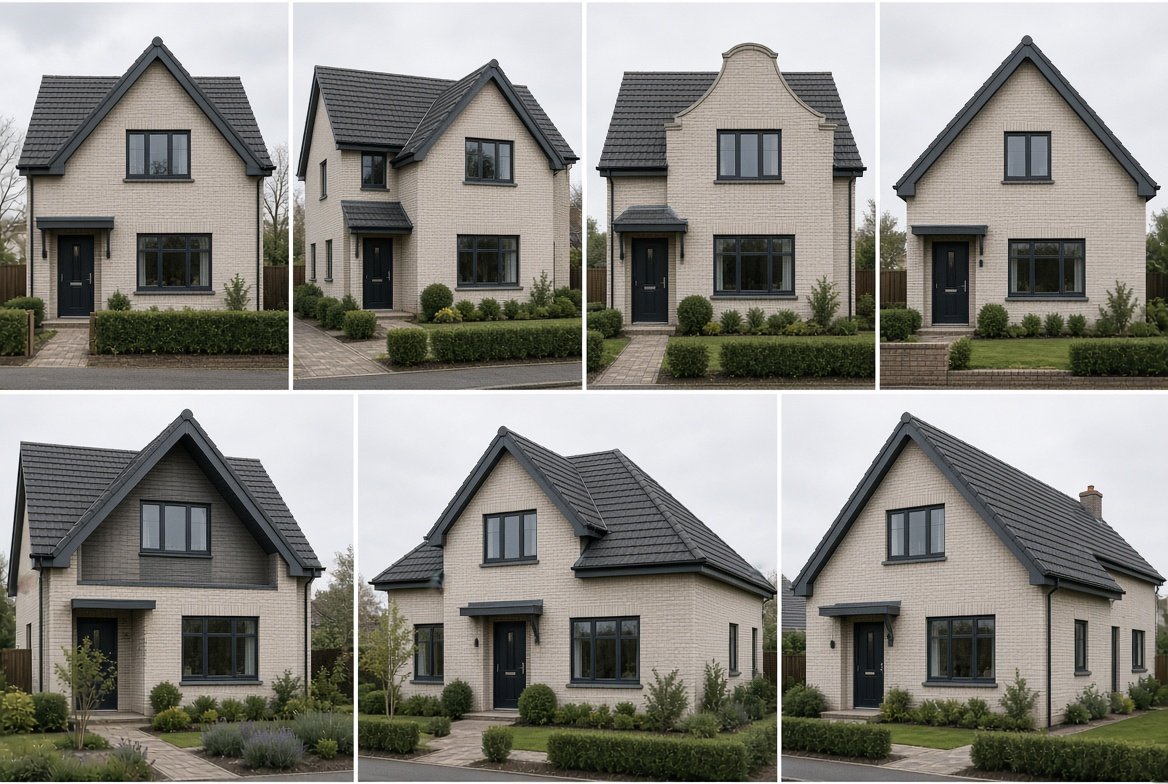
The phrase “gable roof” covers a lot more variety than most homeowners realise. Once you start looking closely at roofs on the street, you will notice small but meaningful differences in how the gable end is built and how the roof planes meet. Here are the seven styles you are most likely to come across on UK homes, and what each one means for cost and character.
1. Standard, or front, gable
This is the simplest and by far the most common form. Two roof planes meet at a central ridge, with a triangular gable wall at each end. It is found on the vast majority of terraced and semi-detached homes across the UK, and it is usually the cheapest gable style to build or replace, since the framing is straightforward.
2. Cross gable
A cross gable is really two gable roof sections meeting at a right angle, often where a side extension, garage, or wing joins the main house. Where the two roofs intersect, a valley is formed, which needs careful flashing to stay watertight. Cross gables add visual interest to a property but also add a maintenance point, since valleys are one of the more common places for leaks to develop over time.
3. Dutch gable, also called a gablet
A Dutch gable is a hybrid design. A small gable sits on top of what is otherwise a hip roof. This combines some of the wind resistance benefits of a hip roof lower down with extra loft headroom and ventilation from the gable section above. It is a popular choice where homeowners want a hip roof’s weather performance without fully losing the loft space benefits of a gable.
Want a number specific to your roof?
Get matched with local roofers for a free, no obligation quote.
4. Box gable
A box gable is a gable end that is boxed in with a triangular frame extending slightly beyond the wall line, rather than the roof simply overhanging the wall. This gives a more finished, three dimensional look to the gable end and is common on detached new builds where a slightly more architectural appearance is wanted.
5. Open gable
An open gable is the plainest version. The roof edge simply overhangs the gable wall without any additional boxed framing. It is typically the most economical style to construct, since it needs the least extra material and labour at the gable end itself.
6. Gable on hip
Similar in concept to a Dutch gable, but with a larger gable section relative to the hip base beneath it. This style is often chosen specifically to maximise loft conversion potential, while still keeping some of the wind resistance a hip roof provides at the lower edges of the building.
7. Front to back gable
Instead of running side to side across the width of the building, the ridge on a front to back gable runs from front to rear, placing the triangular gable ends on the front and rear elevations rather than the sides. This is common on narrow fronted terraced housing, where this orientation often suits the shape of the plot better than a side to side ridge would.
Comparison at a glance
| Style | Typical cost | Best suited to |
|---|---|---|
| Standard gable | Lowest | Most homes, straightforward replacements |
| Open gable | Low | Budget conscious rebuilds |
| Cross gable | Medium | Homes with extensions or wings |
| Box gable | Medium | New builds wanting a finished look |
| Dutch gable | Medium to high | Balancing wind resistance and loft space |
| Gable on hip | Medium to high | Loft conversions in exposed areas |
| Front to back gable | Similar to standard | Narrow fronted terraced homes |
Why the type matters when comparing quotes
More complex styles, particularly cross gables and Dutch gables, involve more valleys, more flashing detail, and more complicated framing than a standard gable. This generally increases labour cost. When comparing quotes from different roofers, it is worth double checking that everyone is pricing the same style of gable roof, since a simplified version of your roof shape can make one quote look cheaper than it really is for the job you actually need done.
Frequently asked questions
What is the most common gable roof style in the UK?
The standard, or front, gable is by far the most common, found on the majority of terraced and semi-detached homes across the country.
Which gable roof style is cheapest?
Open and standard gable roofs are generally the most affordable to build or replace, since they need the least additional framing at the gable end.
What is the difference between a Dutch gable and a gable on hip roof?
Both combine gable and hip elements, but a gable on hip design typically uses a larger gable section relative to the hip base, giving more loft space than a standard Dutch gable.
Do all gable roof styles cost the same to maintain?
No. Styles with more valleys, such as cross gables, generally need closer and more frequent maintenance checks than simpler standard or open gable designs.
This guide is independent editorial content. It is not sponsored.
Get a professional assessment
If you are unsure how much life your current roof has left, a local roofer can give you an honest assessment as part of a free inspection. Browse vetted roofers through our roofer directory, or get a quick replacement estimate using our free cost calculator.